


Page 345 - (DK Eyewitness) Travel Guide - Italy
P. 345
SIENA 343
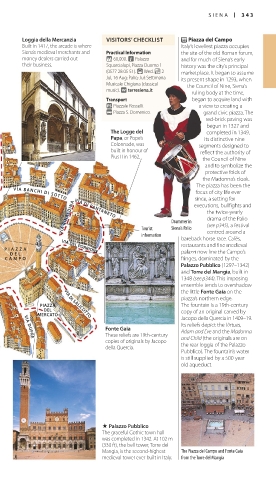
Loggia della Mercanzia VISITORS’ CHECKLIST P Piazza del Campo
Built in 1417, the arcade is where Italy’s loveliest piazza occupies
Siena’s medieval merchants and Practical Information the site of the old Roman forum,
money dealers carried out * 60,000. n Palazzo and for much of Siena’s early
their business. Squarcialupi, Piazza Duomo 1 history was the city’s principal
(0577 28 05 51). ( Wed. _ 2 marketplace. It began to assume
Jul, 16 Aug: Palio; Jul: Settimana its present shape in 1293, when
Musicale Chigiana (classical the Council of Nine, Siena’s
music). ∑ terresiena.it ruling body at the time,
Transport began to acquire land with
V Piazzale Rosselli. a view to creating a
@ Piazza S. Domenico. grand civic piazza. The
red-brick paving was
begun in 1327 and
The Logge del completed in 1349,
Papa, or Pope’s segments designed to
its distinctive nine
VIA BANCHI DI SOPRA Pius II in 1462. reflect the authority of
Colonnade, was
built in honour of
the Council of Nine
and to symbolize the
protective folds of
the Madonna’s cloak.
The piazza has been the
focus of city life ever
since, a setting for
VIA BANCHI DI SOT TO
executions, bullfights and
the twice-yearly
VIA RINALDINAVIA DI PANTANETO Tourist Drummer in drama of the Palio
(see p345), a festival
Siena’s Palio
centred around a
information
bareback horse race. Cafés,
restaurants and fine medieval
PIA ZZ A VIA DEL PORRIONE
DEL palazzi now line the Campo’s
C AMPO fringes, dominated by the
Palazzo Pubblico (1297–1342)
and Torre del Mangia, built in
1348 (see p344). This imposing
ensemble tends to overshadow
the little Fonte Gaia on the
piazza’s northern edge.
PIAZZA VIA DI SALICOTTO The fountain is a 19th-century
DEL
MERCATO copy of an original carved by
Jacopo della Quercia in 1409–19.
Its reliefs depict the Virtues,
Fonte Gaia Adam and Eve and the Madonna
These reliefs are 19th-century and Child (the originals are on
copies of originals by Jacopo the rear loggia of the Palazzo
VIA DUPRE
della Quercia.
Pubblico). The fountain’s water
is still supplied by a 500-year-
old aqueduct.
. Palazzo Pubblico
The graceful Gothic town hall
was completed in 1342. At 102 m
(330 ft), the bell tower, Torre del
Mangia, is the second-highest The Piazza del Campo and Fonte Gaia
medieval tower ever built in Italy. from the Torre del Mangia
342-343_EW_Italy.indd 343 26/04/16 5:17 pm

