


Page 358 - (DK Eyewitness) Travel Guide - Italy
P. 358
356 CENTR AL IT AL Y
1 Gubbio
Perugia. * 33,000. V Fossato di
Vico-Gubbio. @ n Via della Repub-
blica 15 (075 922 06 93). ( Tue.
Gubbio vies with Assisi for the
title of Umbria’s most medieval
town. The beauty of its twisting
streets and terracotta-tiled
houses is enhanced by the forest-
swathed Apennines. Founded by
the Umbrians in the 3rd century
BC as Tota Ikuvina, it assumed
greater prominence in the
1st century AD as a Roman
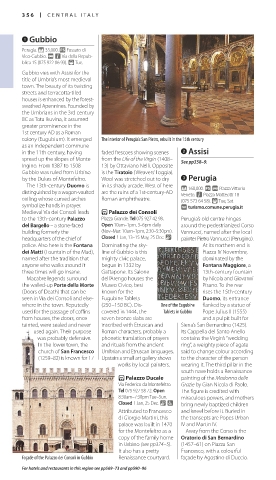
colony (Eugubium). It emerged The interior of Perugia’s San Pietro, rebuilt in the 15th century
as an independent commune
in the 11th century, having faded frescoes showing scenes 2 Assisi
spread up the slopes of Monte from the Life of the Virgin (1408– See pp358–9.
Ingino. From 1387 to 1508 13) by Ottaviano Nelli. Opposite
Gubbio was ruled from Urbino is the Tiratoio (Weavers’ Loggia).
by the Dukes of Montefeltro. Wool was stretched out to dry 3 Perugia
The 13th-century Duomo is in its shady arcade. West of here * 160,000. V @ Piazza Vittorio
distinguished by a wagon-vaulted are the ruins of a 1st-century-AD Veneto. n Piazza Matteotti 18
ceiling whose curved arches Roman amphitheatre. (075 573 64 58). ( Tue, Sat.
symbolize hands in prayer. ∑ turismo.comune.perugia.it
Medi eval Via dei Consoli leads P Palazzo dei Consoli
to the 13th-century Palazzo Piazza Grande. Tel 075 927 42 98. Perugia’s old centre hinges
del Bargello – a stone-faced Open 10am–1pm, 3–6pm daily around the pedestrianized Corso
building formerly the (Nov–Mar: 10am–1pm, 2:30–5:30pm). Vannucci, named after the local
headquarters of the chief of Closed 1 Jan, 13–15 May, 25 Dec. & painter Pietro Vannucci (Perugino).
police. Also here is the Fontana Dominating the sky- At its northern end is
dei Matti (Fountain of the Mad), line of Gubbio is this Piazza IV Novembre,
named after the tradit ion that mighty civic palace, dominated by the
anyone who walks around it begun in 1332 by Fontana Maggiore, a
three times will go insane. Gattapone. Its Salone 13th-century fountain
Macabre legends surround dell’Arengo houses the by Nicola and Giovanni
the walled-up Porte della Morte Museo Civico, best Pisano. To the rear
(Doors of Death) that can be known for the rises the 15th-century
seen in Via dei Consoli and else- Eugubine Tablets Duomo, its entrance
where in the town. Reputedly (250–150 BC). Dis- One of the Eugubine flanked by a statue of
used for the passage of coffins covered in 1444, the Tablets in Gubbio Pope Julius II (1555)
from houses, the doors, once seven bronze slabs are and a pulpit built for
tainted, were sealed and never inscribed with Etruscan and Siena’s San Bernardino (1425).
used again. Their purpose Roman characters, probably a Its Cappella del Santo Anello
was probably defensive. phonetic translation of prayers contains the Virgin’s “wedding
In the lower town, the and rituals from the ancient ring”, a weighty piece of agate
church of San Francesco Umbrian and Etruscan languages. said to change colour according
(1259–82) is known for 17 Upstairs a small art gallery shows to the character of the person
works by local painters. wearing it. The third pillar in the
south nave holds a Renaissance
P Palazzo Ducale painting of the Madonna delle
Via Federico da Montefeltro. Grazie by Gian Nicola di Paolo.
Tel 075 927 58 72. Open The figure is credited with
8:30am–7:30pm Tue–Sun. miraculous powers, and mothers
Closed 1 Jan, 25 Dec. & 7 bring newly baptized children
Attributed to Francesco and kneel before it. Buried in
di Giorgio Martini, this the transepts are Popes Urban
palace was built in 1470 IV and Martin IV.
for the Montefeltro as a Away from the Corso is the
copy of the family home Oratorio di San Bernardino
in Urbino (see pp374–5). (1457–61) on Piazza San
It also has a pretty Francesco, with a colourful
Façade of the Palazzo dei Consoli in Gubbio Renaissance courtyard. façade by Agostino di Duccio.
For hotels and restaurants in this region see pp569–73 and pp590–96
356-357_EW_Italy.indd 356 4/4/17 5:35 PM

