


Page 359 - (DK Eyewitness) Travel Guide - Italy
P. 359
UMBRIA 357
Beyond the old city walls on E Galleria Nazionale
Borgo XX Giugno stands San dell’Umbria
Pietro. Founded in the 10th Palazzo dei Priori, Corso Vannucci 19.
century and rebuilt in 1463, the Tel 075 58 66 84 10. Open Tue–Sun.
best feature of the fine interior is Closed 1 Jan, 1 May, 25 Dec. & 7
the wooden choir (1526). Umbria’s greatest collection of
Piazza Giordano Bruno is paintings is displayed here on
home to San Domenico (1305– the third floor of the palace.
1632), Umbria’s largest church, Most of the works are 13th- to
which is known for the Gothic 18th-century paintings by local
tomb of Benedict XI (c.1304) artists, but the highlights are
and decoration by Agostino altarpieces by Piero della
di Duccio. Francesca and Fra Angelico.
E Museo Archeologico
Nazionale dell’Umbria 4 Lake Trasimeno
San Domenico, Piazza Giordano Bruno Perugia. V @ Castiglione del Lago.
10. Tel 075 572 71 41. Open daily. Medieval street in Perugia n Piazza Mazzini 10, Castiglione del
Closed 1 Jan, 1 May, 25 Dec. & 7 Lago (075 965 24 84).
Housed in the cloisters of San Perugia. The Sala di Udienza del ∑ umbriatourism.it
Domenico, this museum Collegio della Mercanzia, built
exhibits prehistoric, Etruscan around 1390, was formerly Edged with low hills, this is
and Roman artifacts. used by the Merchants’ Guild. Italy’s fourth-largest lake.
This room is late Gothic in style, Its miles of placid water and
P Palazzo dei Priori with exquisite panelling and reed-lined shores have a
Corso Vannucci 19. Tel 075 573 64 58. 15th-century inlaid wood. tranquil, melancholy beauty.
Open daily (Sun: am only). Also in the palace Drainage of the lake began
Closed 1 Jan, 1 May, 25 is the Collegio del under the Romans, but today
Dec & 1st Mon each Cambio, Perugia’s the lake is gently drying up of
month. 7 Collegio del former money its own accord. The town of
Cambio: Open daily. exchange, which Castiglione del Lago, jutting
The monumental was begun in 1452. out on a fortified promontory,
walls and bristling This room was used has an easy-going atmosphere
crenellations of this by the Bankers’ Guild. and small sandy beaches.
palace mark it as Its walls are covered The 16th-century castle is used
Umbria’s finest public with superlative for summer concerts. The church
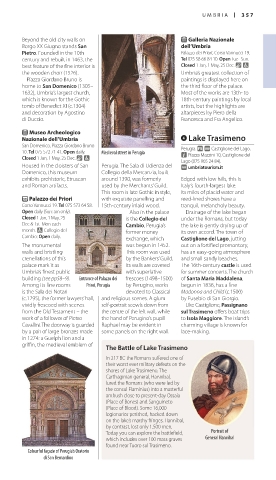
building (see pp58–9). Entrance of Palazzo dei frescoes (1498–1500) of Santa Maria Maddalena,
Among its fine rooms Priori, Perugia by Perugino, works begun in 1836, has a fine
is the Sala dei Notari devoted to Classical Madonna and Child (c.1500)
(c.1295), the former lawyers’ hall, and religious scenes. A glum by Eusebio di San Giorgio.
vividly frescoed with scenes self-portrait scowls down from Like Castiglione, Passignano
from the Old Testament – the the centre of the left wall, while sul Trasimeno offers boat trips
work of a follower of Pietro the hand of Perugino’s pupil to Isola Maggiore. The island’s
Cavallini. The doorway is guarded Raphael may be evident in charming village is known for
by a pair of large bronzes made some panels on the right wall. lace-making.
in 1274: a Guelph lion and a
griffin, the medieval emblem of
The Battle of Lake Trasimeno
In 217 BC the Romans suffered one of
their worst ever military defeats on the
shores of Lake Trasimeno. The
Carthaginian general, Hannibal,
lured the Romans (who were led by
the consul Flaminius) into a masterful
ambush close to present-day Ossaia
(Place of Bones) and Sanguineto
(Place of Blood). Some 16,000
legionaries perished, hacked down
on the lake’s marshy fringes. Hannibal,
by contrast, lost only 1,500 men.
Today you can explore the battlefield, Portrait of
which includes over 100 mass graves General Hannibal
found near Tuoro sul Trasimeno.
Colourful façade of Perugia’s Oratorio
di San Bernardino
356-357_EW_Italy.indd 357 4/4/17 5:35 PM

