


Page 365 - (DK Eyewitness) Travel Guide - Italy
P. 365
UMBRIA 363
P Pozzo di San Patrizio altarpieces and sacred objects
Viale San Gallo. Tel 0763 34 37 68. in the Pinacoteca Comunale,
Open daily. & allows entry at Museo also housed in the palace.
d’Arte Moderna. A few steps from the piazza
This well was commissioned in rises San Fortunato (1292–
1527 by Pope Clement VII and 1462), named after Todi’s first
designed by the Florentine bishop, with a florid Gothic
architect Antonio da Sangallo to doorway (1415–58). The high-
provide the town with a water vaulted plan is based on German
supply in case of attack. Two Gothic “hall” churches and the
248-step staircases drop into its “barn” churches of Tuscany,
dank interior, cleverly arranged characterized by a low-pitched
as a double helix (spiral) so as vault, polygonal apse and naves
not to intersect. The 62 m (203 ft) and aisles of equal height. The
shaft took 10 years to complete. The beautiful hill-town of Todi in choir (1590) is superb, but the
southern Umbria church’s most famous work is
T Necropoli Etrusca – Madonna and Child (1432) by
Crocifisso del Tufo 6 Todi Masolino da Panicale (fourth
Strada Statale 71 to Orvieto Scalo, km Perugia. * 17,000. V @ n Piazza chapel on the right). The crypt
1,600. Tel 0763 34 36 11. Open Umberto I 6 (075 894 54 16). ( Sat. contains the tomb of Jacopone
10am–7pm (Oct–Mar: to 5pm) daily. da Todi (c.1228–1306), a noted
Closed 1 Jan, 1 May, 25 Dec. & 7 Looking down over the Tiber medieval poet and mystic.
This Etruscan necropolis from valley from its hilltop eyrie, Todi To the right of the church are
the 6th century BC has burial is one of the most strikingly some shady gardens, from
chambers built of blocks of tufa. situated of Umbria’s famous which a path (past the tiny
Etruscan letters, thought to be hill-towns. An ancient Etruscan, castle) drops through the trees
the names of the deceased, are and then Roman, settlement, to emerge in front of Santa
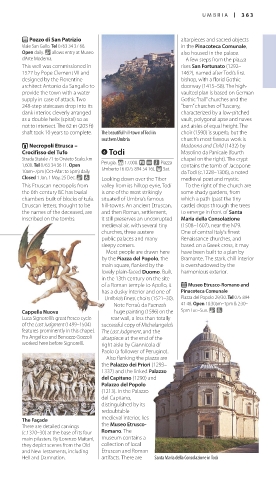
inscribed on the tombs. it still preserves an uncorrupted Maria della Consolazione
medieval air, with several tiny (1508–1607), near the N79.
churches, three austere One of central Italy’s finest
public palaces and many Renaissance churches, and
sleepy corners. based on a Greek cross, it may
Most people are drawn here have been built to a plan by
by the Piazza del Popolo, the Bramante. The stark, chill interior
main square, flanked by the is overshadowed by the
lovely plain-faced Duomo. Built harmonious exterior.
in the 13th century on the site
of a Roman temple to Apollo, it E Museo Etrusco-Romano and
has a dusky interior and one of Pinacoteca Comunale
Umbria’s finest choirs (1521–30). Piazza del Popolo 29/30. Tel 075 894
Note Ferraù da Faenza’s 41 48. Open 10:30am–1pm & 2:30–
Cappella Nuova huge painting (1596) on the 5pm Tue–Sun. & 7
Luca Signorelli’s great fresco cycle rear wall, a less than totally
of the Last Judgment (1499–1504) successful copy of Michelangelo’s
features prominently in this chapel. The Last Judgment, and the
Fra Angelico and Benozzo Gozzoli altarpiece at the end of the
worked here before Signorelli. right aisle by Giannicola di
Paolo (a follower of Perugino).
Also flanking the piazza are
the Palazzo dei Priori (1293–
1337) and the linked Palazzo
del Capitano (1290) and
Palazzo del Popolo
(1213). In the Palazzo
del Capitano,
distinguished by its
redoubtable
The Façade medieval interior, lies
There are detailed carvings the Museo Etrusco-
(c.1320–30) at the base of its four Romano. The
main pilasters. By Lorenzo Maitani, museum contains a
they depict scenes from the Old collection of local
and New Testaments, including Etruscan and Roman
Hell and Damnation. artifacts. There are Santa Maria della Consolazione in Todi
362-363_EW_Italy.indd 363 4/4/17 5:36 PM

