


Page 366 - (DK Eyewitness) Travel Guide - Italy
P. 366
364 CENTR AL IT AL Y
7 Spoleto built on an ancient necropolis.
Its façade is covered in fascinating
Perugia. * 38,000. V @ n Piazza
della Libertà 7 (0743 21 86 20 or 0743 21 Roman esque relief sculptures,
86 21). ( Fri. ∑ conspoleto.com considered some of the finest
examples in Umbria. From here,
Founded by the Umbrians, head north towards the town
Spoleto was one of central Italy’s centre on Viale Giacomo
most important Roman colonies, Matteotti and Via San Carlo.
a prominence maintained by At the southern end of Piazza
the Lombards, who in the 7th del Mercato is the Arco di Druso,
century made it the capital of a 1st-century-AD Roman arch.
one of their three Italian It is flanked by the church of
dukedoms. After a spell as an Sant’Ansano, whose crypt is
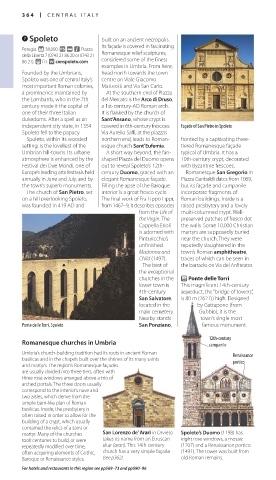
independent city state, in 1354 covered in 6th-century frescoes. Façade of San Pietro in Spoleto
Spoleto fell to the papacy. Via Aurelio Saffi, at the piazza’s
Spoleto, within its wooded northern end, leads to Roman- fronted by a captivating three-
setting, is the loveliest of the esque church Sant’Eufemia. tiered Romanesque façade
Umbrian hill-towns. Its urbane A short way beyond, the fan- typical of Umbria. It has a
atmosphere is enhanced by the shaped Piazza del Duomo opens 10th-century crypt, decorated
Festival dei Due Mondi, one of out to reveal Spoleto’s 12th- with Byzantine frescoes.
Europe’s leading arts festivals held century Duomo, graced with an Romanesque San Gregorio in
annually in June and July, and by elegant Romanesque façade. Piazza Garibaldi dates from 1069,
the town’s superb monuments. Filling the apse of the Baroque but its façade and campanile
The church of San Pietro, set interior is a great fresco cycle. incorporate fragments of
on a hill overlooking Spoleto, The final work of Fra Lippo Lippi, Roman buildings. Inside is a
was founded in 419 AD and from 1467–9, it describes episodes raised presbytery and a lovely
from the Life of multi-columned crypt. Well-
the Virgin. The preserved patches of fresco dot
Cappella Erioli the walls. Some 10,000 Christian
is adorned with martyrs are supposedly buried
Pinturicchio’s near the church. They were
unfinished reputedly slaughtered in the
Madonna and town’s Roman amphitheatre,
Child (1497). traces of which can be seen in
The best of the barracks on Via del Anfiteatro.
the exceptional
churches in the P Ponte delle Torri
lower town is This magnificent 14th-century
4th-century aqueduct, the “bridge of towers”,
San Salvatore, is 80 m (262 ft) high. Designed
located in the by Gattapone (from
main cemetery. Gubbio), it is the
Nearby stands town’s single most
Ponte delle Torri, Spoleto San Ponziano, famous monument.
12th-century
Romanesque churches in Umbria campanile
Umbria’s church-building tradition had its roots in ancient Roman Renaissance
basilicas and in the chapels built over the shrines of its many saints portico
and martyrs. The region’s Romanesque façades
are usually divided into three tiers, often with
three rose windows arranged above a trio of
arched portals. The three doors usually
correspond to the interior’s nave and
two aisles, which derive from the
simple barn-like plan of Roman
basilicas. Inside, the presbytery is
often raised in order to allow for the
building of a crypt, which usually
contained the relics of a saint or
martyr. Many of the churches San Lorenzo de’ Arari in Orvieto Spoleto’s Duomo (1198) has
took centuries to build, or were takes its name from an Etruscan eight rose windows, a mosaic
repeatedly modified over time, altar (arari). This 14th-century (1207) and a Renaissance portico
often acquiring elements of Gothic, church has a very simple façade (1491). The tower was built from
Baroque or Renaissance styles. (see p362). old Roman remains.
For hotels and restaurants in this region see pp569–73 and pp590–96
364-365_EW_Italy.indd 364 4/4/17 5:36 PM
Eyewitness Travel LAYERS PRINTED:
Catalogue template “UK” LAYER
(Source v2)
Date 14th November 2012
Size 125mm x 217mm

