


Page 42 - (DK Eyewitness) Travel Guide - Italy
P. 42
40 INTRODUCING IT AL Y
Music and Opera in Italy
Before Italy’s unification, particularly during the 17th The Baroque Era
and 18th centuries, each major city had its own traditions
of music-making. Rome, as the papal city, had musical Claudio Monteverdi’s music
straddled the transition from
traditions less hedonistic than elsewhere, and avoided the Renaissance period to
opera. Florence had its day at the turn of the 16th century, 17th-century Baroque. The
with its celebrated camerata (groups set on reviving the word baroque means “highly
traditions of ancient Greek spectacle). Venice fostered ornamented, even bizarre”,
church music on a grand scale, and Naples, during the and embellishment was rife.
18th century, was renowned for comic opera. In the Monteverdi’s madrigals began
as standard pieces for four
19th century, Milan became the undisputed heart voices but ended up as
of Italian opera, centred on La Scala. mini-operas. This
was due to the
popularity of
the Ars Perfecta an individual
The Medieval and style, culminating instrumental
Renaissance Periods
with composer style and the
Through Boccaccio (see p38), Giovanni Pierluigi development of
among others, it is known that da Pale strina (1525– the basso continuo
singing, dancing and poetry 94). His vocal (a supporting
often went hand in hand in style subjected organ, harpsichord
medieval and Renaissance Italy. dissonance to or lute that
Italy concentrated on music as strict control, La Pietà, Venice, where unleashed the
part of a spectacle rather than and it was employed Vivaldi performed possibility for solos
as a pure art form. for most church music and duets). At this point, the
Important contributors to during his lifetime. Madrigals beginnings of the string
the music of these periods (vocal settings of poems by orchestra were in place.
include Guido d’Arezzo Petrarch and other poets) were A new fashion for declamation
(c.995–1050), a monk who also popular. meant that various emotional
perfected musical notation, The early 17th century saw states were being represented
and Francesco Landini (1325– Italian composers such as Carlo with sighs and sobs rather than
97), one of the first known Gesualdo da Venosa (c.1561– just description. Monteverdi’s
composers whose songs 1613) and Claudio Monteverdi Vespers followed others in
displayed a distinct concern challenge these traditions by exploiting the stereophonic
for lyricism. The next 150 years introducing more declamation possibilities of San Marco in
were to be characterized by and more of the unexpected. Venice by contrasting different
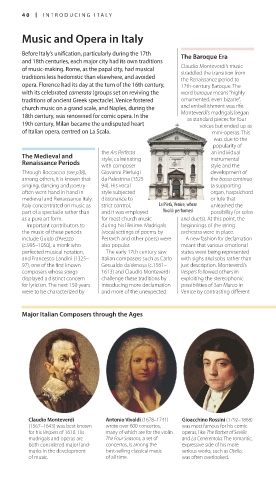
Major Italian Composers through the Ages
Claudio Monteverdi Antonio Vivaldi (1678–1741) Gioacchino Rossini (1792–1868)
(1567–1643) was best known wrote over 600 concertos, was most famous for his comic
for his Vespers of 1610. His many of which are for the violin. operas, like The Barber of Seville
madrigals and operas are The Four Seasons, a set of and La Cenerentola. The romantic,
both considered major land - concertos, is among the expressive side of his more
marks in the develop ment best-selling classical music serious works, such as Otello,
of music. of all time. was often overlooked.
040-041_EW_Italy.indd 40 4/4/17 5:32 PM

