


Page 407 - (DK Eyewitness) Travel Guide - Italy
P. 407
ROME : AROUND PIAZZA NA VONA 405
gambling proceeds of Raffaele
Riario, a nephew of Pope Sixtus
I. In 1478 Riario was involved in
the Pazzi conspiracy against the
Medici, and when Giovanni de’
Medici became Pope Leo XIII in
1513, he took belated revenge,
seizing the palace and turning it
into the papal chancellery.
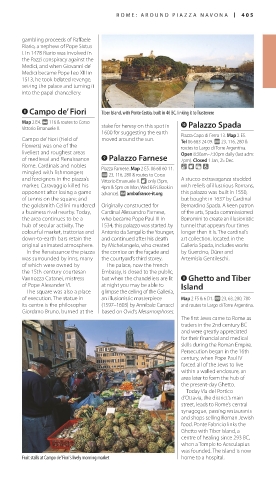
8 Campo de’ Fiori Tiber Island, with Ponte Cestio, built in 46 BC, linking it to Trastevere
Map 2 E4. @ 116 & routes to Corso 0 Palazzo Spada
Vittorio Emanuele II. stake for heresy on this spot in
1600 for suggesting the earth Piazza Capo di Ferro 13. Map 2 E5.
Campo de’ Fiori (Field of moved around the sun. Tel 06 683 24 09. @ 23, 116, 280 &
Flowers) was one of the routes to Largo di Torre Argentina.
liveliest and roughest areas Open 8:30am–7:30pm daily (last adm:
of medieval and Renaissance 9 Palazzo Farnese 7pm). Closed 1 Jan, 25 Dec.
Rome. Cardinals and nobles Piazza Farnese. Map 2 E5. 06 68 60 11. & 8 = 7
mingled with fishmongers @ 23, 116, 280 & routes to Corso
and foreigners in the piazza’s Vittorio Emanuele II. 8 only (3pm, A stucco extravaganza studded
market; Caravaggio killed his 4pm & 5pm on Mon, Wed & Fri. Book in with reliefs of illustrious Romans,
opponent after losing a game advance). ∑ ambafrance-it.org this palazzo was built in 1550,
of tennis on the square; and but bought in 1637 by Cardinal
the goldsmith Cellini murdered Originally constructed for Bernardino Spada. A keen patron
a business rival nearby. Today, Cardinal Alessandro Farnese, of the arts, Spada com missioned
the area continues to be a who became Pope Paul III in Borromini to create an illusionistic
hub of secular activity. The 1534, this palazzo was started by tunnel that appears four times
colour ful market, trattorias and Antonio da Sangallo the Younger, longer than it is. The cardinal’s
down-to-earth bars retain the and continued after his death art collection, located in the
original animated atmosphere. by Michelangelo, who created Galleria Spada, includes works
In the Renaissance the piazza the cornice on the façade and by Guercino, Dürer and
was surrounded by inns, many the courtyard’s third storey. Artemisia Gentileschi.
of which were owned by The palace, now the French
the 15th-century courtesan Embassy, is closed to the public,
Vannozza Catanei, mistress but when the chandeliers are lit q Ghetto and Tiber
of Pope Alexander VI. at night you may be able to Island
The square was also a place glimpse the ceiling of the Galleria,
of execution. The statue in an illusionistic masterpiece Map 2 F5 & 6 D1. @ 23, 63, 280, 780
its centre is the philosopher (1597–1603) by Annibale Carracci and routes to Largo di Torre Argentina.
Giordano Bruno, burned at the based on Ovid’s Metamorphoses.
The first Jews came to Rome as
traders in the 2nd century BC
and were greatly appreciated
for their financial and medical
skills during the Roman Empire.
Persecution began in the 16th
century, when Pope Paul IV
forced all of the Jews to live
within a walled enclosure, an
area later to form the hub of
the present-day Ghetto.
Today Via del Portico
d’Ottavia, the district’s main
street, leads to Rome’s central
synagogue, passing restaurants
and shops selling Roman Jewish
food. Ponte Fabricio links the
Ghetto with Tiber Island, a
centre of healing since 293 BC,
when a Temple to Aesculapius
was founded. The island is now
Fruit stalls at Campo de’ Fiori’s lively morning market home to a hospital.
404-405_EW_Italy.indd 405 4/4/17 5:36 PM

