


Page 411 - (DK Eyewitness) Travel Guide - Italy
P. 411
ROME : AROUND PIAZZA NA VONA 409
u Sant’Ignazio di o Piazza di
Loyola Montecitorio
Piazza di Sant’Ignazio. Map 2 F4. Map 2 F3. Palazzo di Montecitorio
Tel 06 679 44 06. @ 117, 119, Tel 06 676 01. @ 116. Open 10am–
492. Open 7:30am–7pm daily (from 3:30pm 1st Sun of month (except Jul,
9am Sun). 5 Aug & 1st week of Sep).
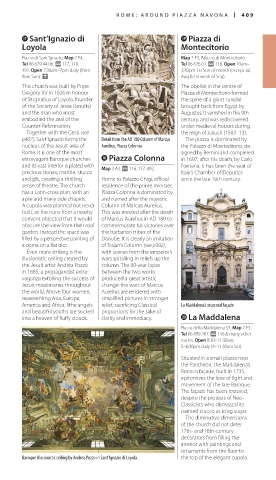
This church was built by Pope The obelisk in the centre of
Gregory XV in 1626 in honour Piazza di Montecitorio formed
of St Ignatius of Loyola, founder the spine of a giant sundial
of the Society of Jesus (Jesuits) brought back from Egypt by
and the man who most Augustus. It vanished in the 9th
embodied the zeal of the century, and was rediscovered
Counter-Reformation. under medieval houses during
Together with the Gesù (see the reign of Julius II (1503–13).
p407), Sant’Ignazio forms the Detail from the AD 180 Column of Marcus The piazza is dominated by
nucleus of the Jesuit area of Aurelius, Piazza Colonna the Palazzo di Montecitorio, de -
Rome. It is one of the most signed by Bernini and completed
extravagant Baroque churches i Piazza Colonna in 1697, after his death, by Carlo
and its vast interior is plated with Map 3 A3. @ 116, 117, 492. Fontana. It has been the seat of
precious stones, marble, stucco Italy’s Chamber of Deputies
and gilt, creating a thrilling Home to Palazzo Chigi, official since the late 19th century.
sense of theatre. The church residence of the prime minister,
has a Latin-cross plan, with an Piazza Colonna is dominated by
apse and many side chapels. and named after the majestic
A cupola was planned but never Column of Marcus Aurelius.
built, as the nuns from a nearby This was erected after the death
convent objected that it would of Marcus Aurelius in AD 180 to
obscure the view from their roof commemorate his victories over
garden. Instead the space was the barbarian tribes of the
filled by a perspective painting of Danube. It is clearly an imitation
a dome on a flat disc. of Trajan’s Column (see p392),
Even more striking is the with scenes from the emperor’s
illusionistic ceiling created by wars spiralling in reliefs up the
the Jesuit artist Andrea Pozzo column. The 80-year lapse
in 1685, a propagandist extra- between the two works
vaganza extolling the success of produced a great artistic
Jesuit missionaries throughout change: the wars of Marcus
the world. Above four women, Aurelius are rendered with
representing Asia, Europe, simplified pictures in stronger
America and Africa, lithe angels relief, sacrificing Classical La Maddalena’s stuccoed façade
and beautiful youths are sucked proportions for the sake of
into a heaven of fluffy clouds. clarity and immediacy. p La Maddalena
Piazza della Maddalena 53. Map 2 F3.
Tel 06 899 281. @ 116 & many other
routes. Open 8:30–11:30am,
5–6:30pm daily (9–11:30am Sat).
Situated in a small piazza near
the Pantheon, the Maddalena’s
Rococo façade, built in 1735,
epitomizes the love of light and
movement of the late Baroque.
The façade has been restored,
despite the protests of Neo-
Classicists who dismissed its
painted stucco as icing sugar.
The diminutive dimensions
of the church did not deter
17th- and 18th-century
decorators from filling the
interior with paintings and
ornaments from the floor to
Baroque illusionistic ceiling by Andrea Pozzo in Sant’Ignazio di Loyola the top of the elegant cupola.
408-409_EW_Italy.indd 409 4/4/17 5:36 PM

