


Page 428 - (DK Eyewitness) Travel Guide - Italy
P. 428
426 ROME AND LAZIO
Exploring the Vatican’s Collections
The Vatican’s greatest treasures are its superlative Greek and
Roman antiquities, together with the mag nificent artifacts
excavated from Egyptian and Etruscan tombs during the
19th century. Some of Italy’s greatest artists, such as Raphael,
Michelangelo and Leonardo da Vinci, are represented in
the Pinacoteca (art gallery) and parts of the former palaces,
where they were employed by popes to decorate sumptuous
apartments and galleries.
Here, the most famous exhibits
Egyptian and are the gold jewellery and
Assyrian Art
bronze throne, bed and funeral
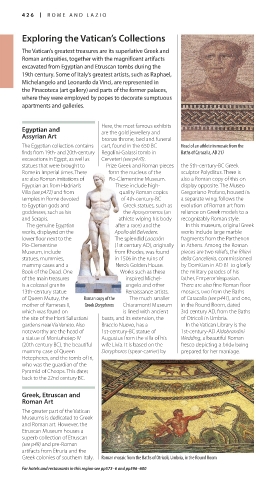
The Egyptian collection contains cart, found in the 650 BC Head of an athlete in mosaic from the
finds from 19th- and 20th-century Regolini-Galassi tomb in Baths of Caracalla, AD 217
excavations in Egypt, as well as Cerveteri (see p470).
statues that were brought to Prize Greek and Roman pieces the 5th-century-BC Greek
Rome in Imperial times. There form the nucleus of the sculptor Polyclitus. There is
are also Roman imitations of Pio-Clementine Museum. also a Roman copy of this on
Egyptian art from Hadrian’s These include high- display opposite. The Museo
Villa (see p472) and from quality Roman copies Gregoriano Profano, housed in
temples in Rome devoted of 4th-century-BC a separate wing, follows the
to Egyptian gods and Greek statues, such as evolution of Roman art from
goddesses, such as Isis the Apoxyomenos (an reliance on Greek models to a
and Serapis. athlete wiping his body recognizably Roman style.
The genuine Egyptian after a race) and the In this museum, original Greek
works, displayed on the Apollo del Belvedere. works include large marble
lower floor next to the The splendid Laocoön fragments from the Parthenon
Pio-Clementine (1st century AD), origin ally in Athens. Among the Roman
Museum, include from Rhodes, was found pieces are two reliefs, the Rilievi
statues, mummies, in 1506 in the ruins of della Cancelleria, commissioned
mummy cases and a Nero’s Golden House. by Domitian in AD 81 to glorify
Book of the Dead. One Works such as these the military parades of his
of the main treasures inspired Michel- father, Emperor Vespasian.
is a colossal granite angelo and other There are also fine Roman floor
13th-century statue Renaissance artists. mosaics, two from the Baths
of Queen Mutuy, the Roman copy of the The much smaller of Caracalla (see p441), and one,
mother of Rameses II, Greek Doryphoros Chiaramonti Museum in the Round Room, dated
which was found on is lined with ancient 3rd century AD, from the Baths
the site of the Horti Sallustiani busts, and its extension, the of Otricoli in Umbria.
gardens near Via Veneto. Also Braccio Nuovo, has a In the Vatican Library is the
noteworthy are the head of 1st-century-BC statue of 1st-century-AD Aldobrandini
a statue of Montuhotep IV Augustus from the villa of his Wedding, a beautiful Roman
(20th century BC), the beautiful wife Livia. It is based on the fresco depicting a bride being
mummy case of Queen Doryphoros (spear-carrier) by prepared for her marriage.
Hetepheres, and the tomb of Iri,
who was the guardian of the
Pyramid of Cheops. This dates
back to the 22nd century BC.
Greek, Etruscan and
Roman Art
The greater part of the Vatican
Museums is dedicated to Greek
and Roman art. However, the
Etruscan Museum houses a
superb collection of Etruscan
(see p48) and pre-Roman
artifacts from Etruria and the
Greek colonies of southern Italy. Roman mosaic from the Baths of Otricoli, Umbria, in the Round Room
For hotels and restaurants in this region see pp573–6 and pp596–600
426-427_EW_Italy.indd 426 26/04/16 5:19 pm
Eyewitness Travel LAYERS PRINTED:
Flashmap follow-on template “UK” LAYER
(Source v1.4)
Date 5th November 2012
Size 125mm x 217mm

