


Page 433 - (DK Eyewitness) Travel Guide - Italy
P. 433
ROME : THE V A TIC AN AND TR ASTE VERE 431
Raphael Rooms
Pope Julius II’s private apartments were built above those
of his hated predecessor, Alexander VI, who died in 1503.
Julius was impressed with Raphael’s work and chose him
to redecorate the four rooms (stanze). Raphael and his
pupils began in 1508, replacing works by better-known
artists, including Raphael’s teacher, Perugino. The new
frescoes quickly established the young artist’s reputation
in Rome, but the project took 16 years to complete and he
died before it was finished.
Temple, showing Heliodorus
felled by a horseman as he tries Key to Floorplan
to rob the Temple in Jerusalem. 1 Hall of Constantine
It alludes to Pope Julius II’s 2 Room of Heliodorus
victory over foreign armies in 3 Room of the Segnatura
Italy. The Mass of Bolsena on the
left wall refers to a miracle that 4 Room of The Fire in the Borgo
occurred in 1263, in which a
priest who doubted the doc Room of The Fire in
trine of the Holy Host was said
to have seen blood issue from it the Borgo
at the moment of sacrifice. This was originally the dining
room, but when the decoration
was completed under Pope
Room of the Segnatura
Leo X it became a music room.
Completed between 1508 and All the frescoes exalt the
1511, the frescoes here are the reigning pope by depicting
most harmonious in the series. events in the lives of his 9th
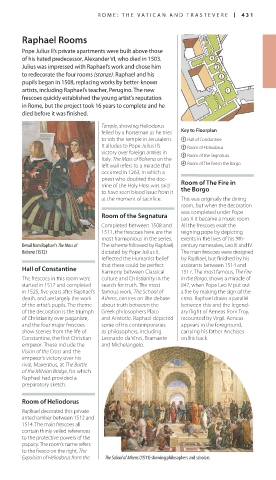
Detail from Raphael’s The Mass of The scheme followed by Raphael, century namesakes, Leo III and IV.
Bolsena (1512) dictated by Pope Julius II, The main frescoes were designed
reflected the Humanist belief by Raphael, but finished by his
that there could be perfect assistants between 1514 and
Hall of Constantine
harmony between Classical 1517. The most famous, The Fire
The frescoes in this room were culture and Christianity in the in the Borgo, shows a miracle of
started in 1517 and completed search for truth. The most 847, when Pope Leo IV put out
in 1525, five years after Raphael’s famous work, The School of a fire by making the sign of the
death, and are largely the work Athens, centres on the debate cross. Raphael draws a parallel
of the artist’s pupils. The theme about truth between the between this and the legend
of the decoration is the triumph Greek philo sophers Plato ary flight of Aeneas from Troy,
of Christianity over paganism, and Aristotle. Raphael depicted recounted by Virgil. Aeneas
and the four major frescoes some of his contemporaries appears in the foreground,
show scenes from the life of as philoso phers, including carrying his father Anchises
Constantine, the first Christian Leonardo da Vinci, Bramante on his back.
emperor. These include the and Michel angelo.
Vision of the Cross and the
emperor’s victory over his
rival, Maxentius, at The Battle
of the Milvian Bridge, for which
Raphael had provided a
preparatory sketch.
Room of Heliodorus
Raphael decorated this private
antechamber between 1512 and
1514. The main frescoes all
contain thinly veiled references
to the protec tive powers of the
papacy. The room’s name refers
to the fresco on the right, The
Expulsion of Heliodorus from the The School of Athens (1511) showing philosophers and scholars
430-431_EW_Italy.indd 431 4/4/17 5:36 PM

