


Page 432 - (DK Eyewitness) Travel Guide - Italy
P. 432
430 ROME AND LAZIO
Sistine Chapel: The Walls
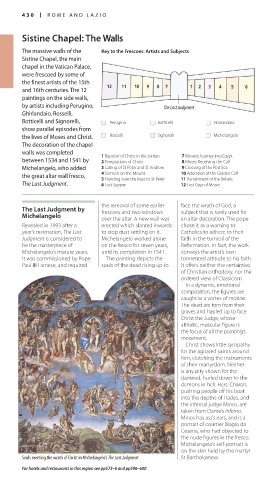
The massive walls of the Key to the Frescoes: Artists and Subjects
Sistine Chapel, the main
chapel in the Vatican Palace,
were frescoed by some of
the finest artists of the 15th
and 16th centuries. The 12
paintings on the side walls,
by artists including Perugino, The Last Judgment
Ghirlandaio, Rosselli,
Botticelli and Signorelli, Perugino Botticelli Ghirlandaio
show parallel episodes from
the lives of Moses and Christ. Rosselli Signorelli Michelangelo
The decoration of the chapel
walls was completed 1 Baptism of Christ in the Jordan 7 Moses’s Journey into Egypt
between 1534 and 1541 by 2 Temptations of Christ 8 Moses Receiving the Call
Michelangelo, who added 3 Calling of St Peter and St Andrew 9 Crossing of the Red Sea
the great altar wall fresco, 4 Sermon on the Mount 10 Adoration of the Golden Calf
11 Punishment of the Rebels
5 Handing over the Keys to St Peter
The Last Judgment. 6 Last Supper 12 Last Days of Moses
the removal of some earlier face the wrath of God, a
The Last Judgment by frescoes and two windows subject that is rarely used for
Michelangelo
over the altar. A new wall was an altar decoration. The pope
Revealed in 1993 after a erected which slanted inwards chose it as a warning to
year’s restoration, The Last to stop dust settling on it. Catholics to adhere to their
Judgment is considered to Michelangelo worked alone faith in the turmoil of the
be the masterpiece of on the fresco for seven years, Reformation. In fact, the work
Michelangelo’s mature years. until its completion in 1541. conveys the artist’s own
It was commissioned by Pope The painting depicts the tormented attitude to his faith.
Paul III Farnese, and required souls of the dead rising up to It offers neither the certainties
of Christian orthodoxy, nor the
ordered view of Classicism.
In a dynamic, emotional
composition, the figures are
caught in a vortex of motion.
The dead are torn from their
graves and hauled up to face
Christ the Judge, whose
athletic, muscular figure is
the focus of all the painting’s
movement.
Christ shows little sympathy
for the agitated saints around
him, clutching the instruments
of their martyrdom. Neither
is any pity shown for the
damned, hurled down to the
demons in hell. Here Charon,
pushing people off his boat
into the depths of Hades, and
the infernal judge Minos, are
taken from Dante’s Inferno.
Minos has ass’s ears, and is a
portrait of courtier Biagio da
Cesena, who had objected to
the nude figures in the fresco.
Michelangelo’s self-portrait is
on the skin held by the martyr
Souls meeting the wrath of Christ in Michelangelo’s The Last Judgment St Bartholomew.
For hotels and restaurants in this region see pp573–6 and pp596–600
430-431_EW_Italy.indd 430 4/4/17 5:36 PM
Eyewitness Travel LAYERS PRINTED:
Flashmap follow-on template “UK” LAYER
(Source v1.4)
Date 5th November 2012
Size 125mm x 217mm

