


Page 540 - (DK Eyewitness) Travel Guide - Italy
P. 540
538 SOUTHERN IT AL Y
6 Marsala the 17th century, was built on the Carthaginians in 409 BC.
the site of an earlier church; Archaeologists regard the temple
Trapani. * 83,000. V @ g n Via
XI Maggio 100 (0923 71 40 97). both were dedicated to Marsala’s as a good example of “work in
( Tue. ∑ consorziovinomarsala.it patron saint, Thomas à Becket of progress”. Nearby, close to the
Canterbury. Its interior is full of summit of Monte Barbaro, the
The port of Marsala is the home sculptural works by members ruins of an ancient theatre (3rd
of a thick, strong, sweet wine of the Gagini family. The small century BC) can be visited. Sum-
that has been in production Museo degli Arazzi, behind mer concerts are now held here.
here since the 18th the Duomo, contains
century. In 1798 several magnificent
Admiral Nelson 16th-century Brussels 8 Selinunte
ordered vast quantities tapestries. Trapani. Tel 0924 462 77.
of it following the Battle V Castelvetrano then bus.
of the Nile. Its early E Museo Archeologico Open 9am–6pm daily (to 4pm in
manufacture was presided Baglio Anselmi winter). &
over by three British Via Lungomare. Tel 0923 95 25
families living in Sicily. One 35. Open 9am–6:30pm Tue– Founded in 651 BC, Selinunte
of the old warehouses Sat & 1st Sun of month; 9am– became one of the great cities
where the wine was 12:30pm Mon, Sun & hols. of Magna Graecia – the part of
produced is now the & 7 southern Italy that was colonized
Museo Archeologico E Museo di Mozia by ancient Greece – and its
Baglio Anselmi, Isola di Mozia. Tel 0923 71 25 98. toppled ruins are among Sicily’s
housing important Open 9:30am–6:30pm daily most important historic sites. Its
Phoenician artifacts. Statue of a (Nov–Mar: 9am–3pm). & 7 ancient name, Selinus, derives
The ruins of Lily Greek youth in E Museo degli Arazzi from the wild celery that still
baeum are another Museo di Mozia Via Garaffa 57. Tel 0923 71 13 grows here. The city was an
attraction. Founded in 27. Open 9am–1pm daily important port, and its wall
397 BC, this outpost of (and 4–6pm Tue–Sat). & defences can still be seen around
the Phoenician Empire was the Acropolis. The Carthaginians,
peopled by the survivors of under Hannibal, completely
the massacre by Dionysius I 7 Segesta destroyed the city in 409 BC in a
of Siracusa at Mozia (ancient Trapani. * 7,500. @ from Trapani & battle famous for its epic and
Motya) – the island used by the Palermo. Tel 0924 95 58 41. Open spectacularly savage proportions.
Phoenicians as a commercial 9am–6:30pm daily (to 4pm in winter). While the city itself has virtually
centre. Best of all are the disappeared, eight of its temples
reconstructed remains of a Punic According to legend, the ancient are distinguishable, particularly
ship thought to have been active town of Segesta – still largely the so-called Eastern Temples
in the First Punic War (263–241 unexcavated – was founded (E, F and G). Of these, the
BC). The Museo di Mozia in by Trojan followers of Aeneas. columns of huge Doric Temple E
the Whitaker villa contains a It presents one of the most (490–480 BC) have been
remarkable early 5th-century BC spectacular sights on the island: partially re-erected. Temple F
statue of a Greek youth. a massive unfinished temple (c.560–540 BC) is in ruins.
The excavations here are stranded on a remote hillside. Temple G (late 6th century BC),
important; what we know of Its construction was started which had 17 massive side
the Phoenicians today comes between 426 and 416 BC, and it columns, was one of the greatest
mostly from the Bible, and from was left incomplete following Greek temples ever built.
Mozia. The Duomo, begun in the devastation of Selinunte by Higher on the Acropolis lie
the remains of Temples A, B, C,
D and O. Metope sculpture from
Temple C (early 6th century),
originally located on the frieze
between the triglyphs, can be
seen in the Museo Archeologico
Regionale in Palermo (see p532),
along with ceramics, jewellery
and other artifacts excavated
here. A small museum on site
houses less important finds, as
does one in Castelvetrano, 14 km
(8.5 miles) north of Selinunte. The
ancient city is still being exca-
vated; its North Gate entrance
is well preserved, and further
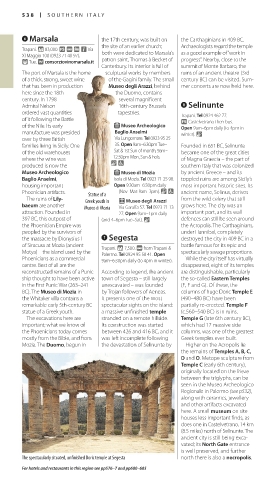
The spectacularly situated, unfinished Doric temple at Segesta north there is also a necropolis.
For hotels and restaurants in this region see pp576–7 and pp600–605
538-539_EW_Italy.indd 538 4/5/17 9:31 AM
Eyewitness Travel LAYERS PRINTED:
Catalogue template “UK” LAYER
(Source v2)
Date 14th November 2012
Size 125mm x 217mm

