


Page 545 - (DK Eyewitness) Travel Guide - Italy
P. 545
SICIL Y 543
y Mount Etna built around 1779, and on
Palazzo Valle (c.1740–50).
Catania. V Linguaglossa or
Randazzo; Circumetnea railway from Carrying on the Vaccarini
Catania to Riposto. @ to Nicolosi. tradition is Stefano Ittar’s San
n Via G. Garibaldi 63, Nicolosi (095 91 Placido (around 1768). The
15 05). To hire a guide: 095 791 47 55. frenzied stone carving on the
∑ turismo.provincia.ct.it Palazzo Biscari (early 18th
century) is exceeded by Antonino
Europe’s highest (3,370 m/ Amato’s unres trained decoration
11,050 ft) and most active of the vast Benedictine convent
volcano, Mount Etna was (1704) and the adjacent huge
thought by the Romans to have church of San Niccolò (1730).
been the forge of Vulcan (god of On Via Vittorio Emanuele
fire). The climb to the summit is the Museo Belliniano,
should be made only with an birthplace of composer
experienced guide. The Circum The façade of Catania’s Duomo Vincenzo Bellini (1801–35).
etnea railway runs around the The lava ruins of the Teatro
base, offering a good alternative contains some of the most Romano (21 BC) are at Piazza
to hiking and good views. imaginative lavabuilt Baroque Stesicono. Verga’s House, home
buildings in Sicily. Piazza del of the great Sicilian novelist
Duomo, featuring a lava Giovanni Verga (1840–1922), is
u Catania elephant (Catania’s symbol) on Via Sant’ Anna. Via Crociferi is
carrying an Egyptian obelisk, home to 18thcentury churches
* 315,000. k V @ n Via Cima
rosa 10 (095 401 40 40). ( Mon–Sat offers a dramatic vista to San Francesco Borgia, San
(general); Sun (antiques & bricabrac). Mount Etna. In 1736, the Benedetto and San Giuliano,
∑ apt-catania.com Norman Duomo was given a whose interior is Vaccarini’s
new façade by Vaccarini, who masterpiece (1760). Further
Having been decimated by the also worked on the Municipio along Via Crociferi, the church
earthquake of 1693, Catania was (finished 1741), on the façade of Santo Carcere contains the
comprehensively rebuilt. While of Sant’Agata (1748), on the prison of St Agatha, who was
it is not immediately beautiful, it designs of Collegio Cutelli, martyred in AD 253.
Influences on Traditional Sicilian Cuisine
Sicily has one of Italy’s most
varied cuisines. The island’s
unique location – marooned
between North Africa, Europe
and the eastern Mediterranean –
and the invaders it attracted are
responsible for this culinary
diversity. The earliest Western
cookbook, the now lost Art of
Cooking (5th century BC), was
written by Mithaecus, a Siracusan
Greek. Sicily’s fertility attracted
Greek colonists, who exported
oil, wheat, honey, cheese,
fruit and vegetables to their
homeland. The Arabs introduced
oranges, lemons, aubergines and
sugar cane. Their love of sweet
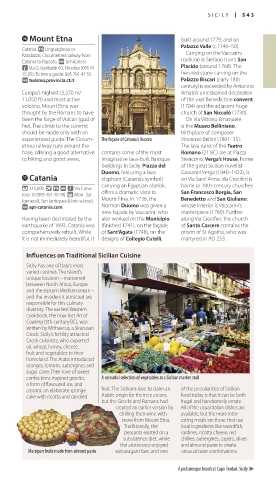
con fections inspired granita, A colourful selection of vegetables at a Sicilian market stall
a form of flavoured ice, and
cassata, an elaborate sponge fruit. The Sicilians love to claim an of the peculiarities of Sicilian
cake with ricotta and candied Arabic origin for their ice cream, food today is that it can be both
but the Greeks and Romans had frugal and handsomely ornate.
created an earlier version by All of the usual Italian dishes are
chilling their wine with available, but the more inter
snow from Mount Etna. esting meals are those that use
Traditionally, the local ingredients like swordfish,
peasants existed on a sardines, ricotta cheese, red
subsistence diet, while chillies, aubergines, capers, olives
the aristocracy enjoyed and almond paste to create
Marzipan fruits made from almond paste extravagant fare, and one unusual taste combinations.
A picturesque beach at Capo Tindari, Sicily
542-543_EW_Italy.indd 543 4/5/17 9:31 AM

