


Page 60 - All About History - Issue 28-15
P. 60
MACHU PICCHU: THE CITY IN THE SKY


                                               was one he had actually already found and   Their methods of conquest were not always
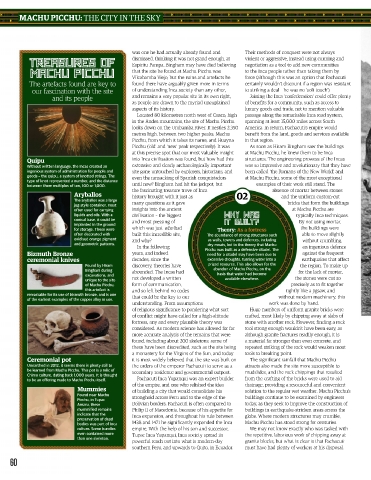
           Treasures of                        dismissed, thinking it was not grand enough, at   violent or aggressive, instead using cunning and
                                               Espiritu Pampa. Bingham may have died believing
                                                                                       negotiation as a tool to add new communities
            Machu Picchu                       that the site he found at Machu Picchu was   to the Inca people rather than taking them by
                                               Vilcabamba Viejo, but the ruins and artefacts he
                                                                                       force (although this was an option that Pachacuti
           The artefacts found are key to      found there have arguably given more in terms   certainly wouldn’t discount if a region was resistant
            our fascination with the site      of understanding Inca society than any other,   to striking a deal – he was no ‘soft touch’).
                   and its people              and remains a very popular site in its own right,   Joining the Inca ‘confederation’ could offer plenty
                                               as people are drawn to the myriad unexplained   of benefits for a community, such as access to
                                               aspects of its history.                 luxury goods and trade, not to mention valuable
                                                 Located 80 kilometres north west of Cusco, high   passage along the remarkable Inca road system,
                                               in the Andes mountains, the site of Machu Picchu   spanning at least 15,000 miles across South
                                               looks down on the Urubamba River. It nestles 2,350   America. In return, Pachacuti’s empire would
                                               metres high, between two higher peaks, Machu   benefit from the land, goods and services available
                                               Picchu, from which it takes its name, and Huayna   in that region.
                                               Picchu (‘old’ and ‘new’ peak respectively). It was   As soon as Hiram Bingham saw the buildings
                                               at this precise spot that our most valuable insight   at Machu Picchu, he knew them to be Inca
           Quipu                               into Inca civilisation was found, but how had this   structures. The engineering prowess of the Incas
           Without written language, the Incas created an   extensive and clearly archaeologically important   was so impressive and revolutionary that they have
           ingenious system of administration for people and   site gone untouched by explorers, historians, and   been called ‘the Romans of the New World’, and
           goods – the quipu, a system of knotted strings. The   even the ransacking of Spanish conquistadors   at Machu Picchu, some of the most exceptional
           type of knot representedanumber,andthedistance
           between them multiples of ten, 100 or 1,000.  until now? Bingham had hit the jackpot, but  examples of their work still stand. The
                                               the fascinating treasure trove of Inca            absence of mortar between stones
                           Aryballos           history brought with it just as      02              and the uniform custom-cut
                           Thearyballoswasalarge
                           jug-style container, most  manyquestionsasitgave                           bricks that form the buildings
                           often used for carrying  insights into the ancient                           at Machu Picchu are
                           liquidsandoils.Witha  civilisation – the biggest     why was                  typically Inca techniques.
                           conical base, it could be                            it built?
                           implanted in the ground  andmostpressingof                                     By not using mortar,
                           for storage. These were  which was just who had   Theory: Asafortress           the buildings were
                           often decorated with  built this incredible site,  The abundance of strong structures such   able to move slightly
                           oxidised orange pigment  and why?              as walls, towers and defences, including   without crumbling,
                           and geometric patterns.                        drymoats,ledtothetheory that Machu
                                                 In the following                                          an ingenious defence
                                                                         Picchu was built as a defensive citadel. The
           Bizmuth Bronze                      years, and indeed          needforacitadelmayhavebeen due to   against the frequent
           ceremonial knives                   decades, since the         excessive droughts, turning water into a   earthquakes that affect
                               Found by Hiram   discovery, theories have  prized resource. This also allows for the   the region. To make up
                               Bingham during   abounded. The Incas had     abandon of Machu Picchu, on the   for the lack of mortar,
                               excavations, and                              basisthatwaterhadbecome
                               unique to the site   not developed a written     available elsewhere.     the stones were cut so
                               of Machu Picchu,   form of communication,                               precisely as to fit together
                               this artefact is   andsoleftbehindnocodes                              tightly like a jigsaw, and
           remarkable for its use of bismuth bronze, and is one
           of the earliest examples of the copper alloy in use.   thatcouldbethekeytoour           without modern machinery, this
                                               understanding. From assumptions                  work was done by hand.
                                               of religious significance to pondering what sort  Huge numbers of uniform granite bricks were
                                               of conflict might have called for a high-altitude  crafted, most likely by chipping away at slabs of
                                               fortress, any and every plausible theory was  stone with another rock. However, finding a rock
                                               considered. As modern science has allowed for far  tool strong enough wouldn’t have been easy, as
                                               more accurate analysis of the remains that were  although granite fractures readily enough, it is
                                               found, including about 200 skeletons, some of  a material far stronger than even concrete, and
                                               these have been discredited, such as the site being  repeated striking of the rock would weaken most
                                               amonasteryfortheVirginsoftheSun,andtoday  tools to breaking point.
           Ceremonial pot                      it is most widely believed that the site was built on  The significant rainfall that Machu Picchu
           Unearthed in 2012, it seems there is plenty still to  theordersoftheemperorPachacutitoserveasa  attracts also made the site more susceptible to
           be learned from Machu Picchu. This pot is a relic of  secondary residence and governmental outpost.  mudslides, and the rock chippings that resulted
           Chimu culture, dating back 1,000 years. It is thought
           to be an offering made to Machu Picchu itself.  PachacutiIncaYupanquiwasanexpertbuilder  from the crafting of the bricks were used to aid
                                               oftheempire,andonewhorelishedtheidea    drainage, providing a resourceful and convenient
                            Mummies            of building a city that would consolidate his  solution to the regular wet weather. Machu Picchu’s
                            Found near Machu
                            Picchu, in Tupac   stronghold across Peru and to the edge of the  buildings continue to be examined by engineers
                            Amaru, these       Bolivian borders. Pachacuti is often compared to  today, as they seek to improve the construction of
                            mummified remains   PhilipIIofMacedonia,becauseofhisappetitefor  buildings in earthquake-stricken areas across the
                            indicate that the   Inca expansion, and throughout his rule between  globe. Where modern structures may crumble,
                            preservation of dead
                            bodies was part of Inca   1438and1471hesignificantlyexpandedtheInca  Machu Picchu has stood strong for centuries.
                            culture. Some bundles   empire. With the help of his son and successor,  We may not know exactly who was tasked with
                            even contained more   TupacIncaYupanqui,Incasocietyspreadits  the repetitive, laborious work of chipping away at
                            than one skeleton.
                                               powerful reach out into what is modern-day  granite blocks, but what is clear is that Pachacuti
                                               southern Peru, and upwards to Quito, in Ecuador.  must have had plenty of workers at his disposal.
     60

