


Page 62 - All About History - Issue 28-15
P. 62
MACHU PICCHU: THE CITY IN THE SKY


        Estimates put the figure of labourers working on
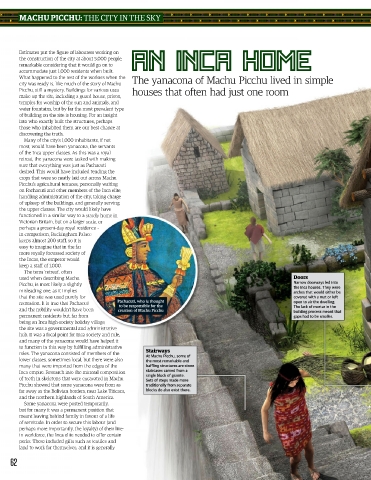
        the construction of the city at about 5,000 people,   An Inca Home
        remarkable considering that it would go on to
        accommodate just 1,000 residents when built.
        What happened to the rest of the workers when the   TheyanaconaofMachuPicchulivedinsimple
        city was ready is, like much of the story of Machu
        Picchu, still a mystery. Buildings for various uses   houses that often had just one room
        make up the site, including a guard house, prison,
        temples for worship of the sun and animals, and
        water fountains, but by far the most prevalent type
        of building on the site is housing. For an insight
        into who exactly built the structures, perhaps
        those who inhabited them are our best chance at
        discovering the truth.
          Many of the city’s 1,000 inhabitants, if not
        most, would have been yanacona, the servants
        of the Inca upper classes. As this was a royal
        retreat, the yanacona were tasked with making
        sure that everything was just as Pachacuti
        desired. This would have included tending the
        crops that were so neatly laid out across Machu
        Picchu’s agricultural terraces, personally waiting
        on Pachacuti and other members of the Inca elite,
        handling administration of the city, taking charge
        of upkeep of the buildings, and generally serving
        the upper classes. The city would likely have
        functioned in a similar way to a  l h  i
        Victorian Britain, but on a larger
        perhaps a present-day royal resid
        in comparison, Buckingham Pal
        keeps almost 200 staff, so it is
        easy to imagine that in the far
        more royally focussed society of
        the Incas, the emperor would
        keep a staff of 1,000.
          The term ‘retreat’, often
        used when describing Machu                                                                      Doors
        Picchu, is most likely a slightly                                                               Narrow doorways led into
                                                                                                        the Inca houses. They were
        misleading one, as it implies                                                                   arches that would either be
        that the site was used purely for                                                               coveredwithamatorleft
        recreation. It is true that Pachacu  Pachacuti, who is thought                                  open to air the dwelling.
                                           to be responsible for the                                    Thelackofmortarinthe
        and the nobility wouldn’t have b   creation of Machu Picchu                                     building process meant that
        permanent residents but, far from                                                               gapshadtobesmaller.
        being an Inca high-society holid
        the site was a governmental and
        hub. It was a focal point for Inca society and rule,
        and many of the yanacona would have helped it
        to function in this way by fulfilling administrative
        roles. The yanacona consisted of members of the   Stairways
                                                    At Machu Picchu, some of
        lower classes, sometimes local, but there were also   themostremarkableand
        many that were imported from the edges of the   baffling structures are stone
        Inca empire. Research into the mineral composition   staircases carved from a
                                                    singleblockofgranite.
        of teeth in skeletons that were excavated in Machu   Sets of steps made more
        Picchu showed that some yanacona were from as   traditionally from separate
        far away as the Bolivian borders, near Lake Titicaca,   blocks do also exist there.
        and the northern highlands of South America.
          Some yanacona were posted temporarily,
        but for many it was a permanent position that
        meant leaving behind family in favour of a life
        of servitude. In order to secure this labour (and
        perhaps more importantly, the loyalty) of their live-
        in workforce, the Inca elite needed to offer certain
        perks. These included gifts such as textiles and
        land to work for themselves, and it is generally
     62

