


Page 29 - (DK Eyewitness) Travel Guide - Mallorca, Menorca & Ibiza
P. 29
A POR TR AIT OF THE BALEARIC ISLANDS 27
Flora
There are some 1,500 species of flow
ering plant on the islands, of which
50 or so are native. Some of them
grow only in Mallorca and the Cabrera
archi pelago. Most flower in spring and
at this time the islands are a blaze of
colour. For the rest of the year, the
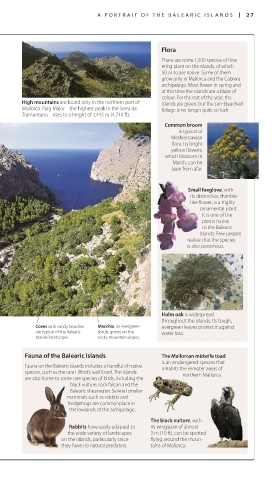
High mountains are found only in the northern part of islands are green, but the sunbleached
Mallorca. Puig Major – the highest peak in the Serra de foliage is no longer quite so lush.
Tramuntana – rises to a height of 1,445 m (4,740 ft).
Common broom
is typical of
Mediterranean
flora. Its bright
yellow flowers,
which blossom in
March, can be
seen from afar.
Small foxglove, with
its distinctive, thimble
like flower, is a highly
ornamental plant.
It is one of the
plants native
to the Balearic
Islands. Few people
realize that the species
is also poisonous.
Holm oak is widespread
throughout the islands. Its tough,
Coves with sandy beaches Macchia, an evergreen evergreen leaves protect it against
are typical of the Balearic shrub, grows on the water loss.
Islands’ landscape. rocky mountain slopes.
Fauna of the Balearic Islands The Mallorcan midwife toad
is an endangered species that
Fauna on the Balearic Islands includes a handful of native inhabits the remoter areas of
species, such as the rare Lilford’s wall lizard. The islands northern Mallorca.
are also home to some rare species of birds, including the
black vulture, rock falcon and the
Balearic shearwater. Several smaller
mammals such as rabbits and
hedgehogs are commonplace in
the lowlands of the archipelago.
The black vulture, with
Rabbits have easily adapted to its wingspan of almost
the wide variety of landscapes 3 m (10 ft), can be spotted
on the islands, particularly since flying around the moun
they have no natural predators. tains of Mallorca.
026-027_EW_Mallorca.indd 27 06/10/17 11:15 am

