


Page 30 - (DK Eyewitness) Travel Guide - Mallorca, Menorca & Ibiza
P. 30
28 INTRODUCING THE BALEARIC ISLANDS A POR TR AIT OF THE BALEARIC ISLANDS 29
The Underwater World The Balearic shearwater, also known as
the “Moresque shearwater”, is a common
Some four million years ago, the Balearic sight. It gathers food by sitting on
the water and catching crustaceans,
archipelago was joined to the continent. The squid and small fish. The
sinking seabed caused the islands to become shearwater is native to
separated from the mainland by the Balearic Sea. the Balearic Islands and
The coastline is topographically varied, featuring nests in large colonies.
sandy beaches with shallows stretching far out The Lilford’s wall lizard can be seen
everywhere, even close to beaches, in
into the sea, and cliffs with distinct layers of rock, dry, sunny places. There are 22 known
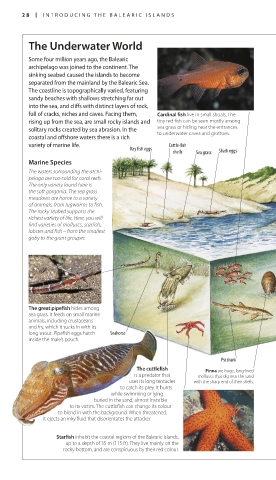
full of cracks, niches and caves. Facing them, Cardinal fish live in small shoals. The subspecies, which are spread throughout
rising up from the sea, are small rocky islands and tiny red fish can be seen mostly among the archipelago.
solitary rocks created by sea abrasion. In the sea grass or hiding near the entrances The Mediterranean monk seal
to underwater caves and grottoes.
coastal and offshore waters there is a rich was once a common sight in the
variety of marine life. Cuttle-fish archipelago but is now almost extinct.
Ray fish eggs Shark eggs
shells Sea grass
Marine Species
The waters surrounding the archi
pelago are too cold for coral reefs.
The only variety found here is
the soft gorgonia. The sea grass Red clingfish have no scales and
meadows are home to a variety attach themselves to the surfaces
of animals, from lugworms to fish. of rocks with a sucker situated
between their ventral fins.
The rocky seabed supports the
richest variety of life. Here, you will The Haliotis clam prefers rocky bottoms
find varieties of molluscs, starfish, close to the shore. This primitive snail is
lobster and fish – from the smallest highly valued by gourmets.
goby to the giant grouper.
The
species
of moray
The great pipefish hides among found in the
sea grass. It feeds on small marine Mediterranean
animals, including crustaceans has no venom, but its bite can be
and fry, which it sucks in with its Mediterranean scallop dangerous. Hidden amid rocks,
long snout. Pipefish eggs hatch Seahorse it springs surprise attacks, feeding
inside the male’s pouch. Gorgonia Link wrasse on fish and crustaceans.
Amarela
Psi shark
The cuttlefish Pinna are huge, long-lived
is a predator that molluscs that dig into the sand The slipper
uses its long tentacles with the sharp end of their shells. lobster is not as
to catch its prey. It hunts common as the
while swimming or lying cicada lobster,
buried in the sand, almost invisible which is twice its
to its victim. The cuttlefish can change its colour size. Its body is
to blend in with the background. When threatened, covered with a
it ejects an inky fluid that disorientates the attacker. hard shell and
is armed with
spikes, while its
Starfish inhabit the coastal regions of the Balearic Islands, antennae have The Dusky grouper is, despite its fearsome size, a
up to a depth of 35 m (115 ft). They live mainly on the evolved into gentle fish. Because of this, and its sheer bulk, it
rocky bottom, and are conspicuous by their red colour. short, wide plates. presents an easy target for spear-fishing.
028-029_EW_Mallorca.indd 28 06/10/17 11:08 am 028-029_EW_Mallorca.indd 29 06/10/17 11:08 am
Eyewitness Travel LAYERS PRINTED:
Feature template “UK” LAYER
(SourceReport v1.3)
Date 18th October 2012
Size 125mm x 217mm

