


Page 31 - (DK Eyewitness) Travel Guide - Mallorca, Menorca & Ibiza
P. 31
A POR TR AIT OF THE BALEARIC ISLANDS 29
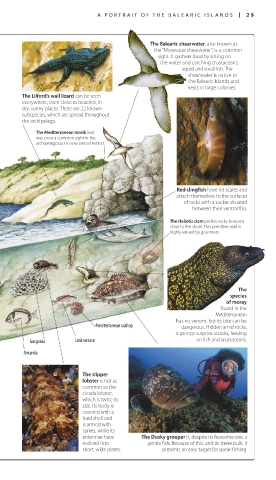
The Balearic shearwater, also known as
the “Moresque shearwater”, is a common
sight. It gathers food by sitting on
the water and catching crustaceans,
squid and small fish. The
shearwater is native to
the Balearic Islands and
nests in large colonies.
The Lilford’s wall lizard can be seen
everywhere, even close to beaches, in
dry, sunny places. There are 22 known
subspecies, which are spread throughout
the archipelago.
The Mediterranean monk seal
was once a common sight in the
archipelago but is now almost extinct.
Red clingfish have no scales and
attach themselves to the surfaces
of rocks with a sucker situated
between their ventral fins.
The Haliotis clam prefers rocky bottoms
close to the shore. This primitive snail is
highly valued by gourmets.
The
species
of moray
found in the
Mediterranean
has no venom, but its bite can be
Mediterranean scallop dangerous. Hidden amid rocks,
it springs surprise attacks, feeding
Gorgonia Link wrasse on fish and crustaceans.
Amarela
The slipper
lobster is not as
common as the
cicada lobster,
which is twice its
size. Its body is
covered with a
hard shell and
is armed with
spikes, while its
antennae have The Dusky grouper is, despite its fearsome size, a
evolved into gentle fish. Because of this, and its sheer bulk, it
short, wide plates. presents an easy target for spear-fishing.
028-029_EW_Mallorca.indd 29 06/10/17 11:08 am

