


Page 24 - World of Animals - Issue #31
P. 24
Ruby-throated hummingbird


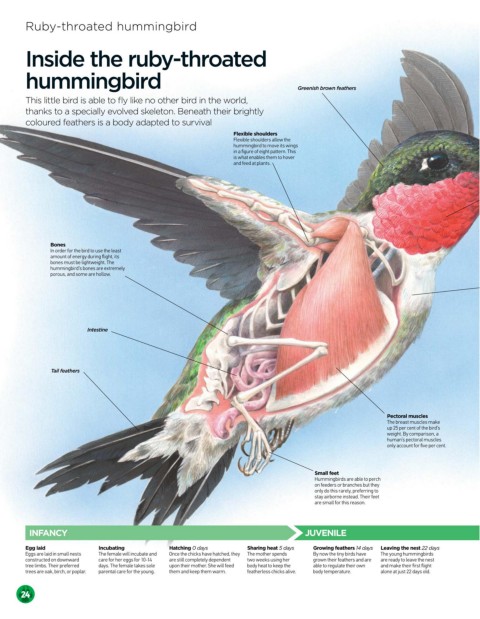
            Inside the ruby-throated


            hummingbird                                                               Greenish brown feathers


            This little bird is able to fly like no other bird in the world,

            thanks to a specially evolved skeleton. Beneath their brightly
            coloured feathers is a body adapted to survival

                                                                     Flexible shoulders
                                                                     Flexible shoulders allow the
                                                                     hummingbird to move its wings

                                                                     in a figure of eight pattern. This
                                                                     is what enables them to hover
                                                                     and feed at plants.


                   Bones
                   In order for the bird to use the least

                   amount of energy during flight, its
                   bones must be lightweight. The
                   hummingbird’s bones are extremely
                   porous, and some are hollow.


                             Intestine


                   Tail feathers


                                                                                                              Pectoral muscles
                                                                                                              The breast muscles make
                                                                                                              up 25 per cent of the bird’s
                                                                                                              weight. By comparison, a
                                                                                                              human’s pectoral muscles

                                                                                                              only account for five per cent.

                                                                                           Small feet
                                                                                           Hummingbirds are able to perch
                                                                                           on feeders or branches but they
                                                                                           only do this rarely, preferring to
                                                                                           stay airborne instead. Their feet
                                                                                           are small for this reason.


             INFANCY                                                                    JUVENILE

            Egg laid            Incubating         Hatching 0 days      Sharing heat 5 days  Growing feathers 14 days  Leaving the nest 22 days
            Eggs are laid in small nests   The female will incubate and   Once the chicks have hatched, they   The mother spends   By now the tiny birds have   The young hummingbirds
            constructed on downward   care for her eggs for 10-14   are still completely dependent   two weeks using her   grown their feathers and are   are ready to leave the nest


            tree limbs. Their preferred   days. The female takes sole   upon their mother. She will feed   body heat to keep the   able to regulate their own   and make their first flight
            trees are oak, birch, or poplar.   parental care for the young.   them and keep them warm.   featherless chicks alive.  body temperature.   alone at just 22 days old.
           24


       018-027_AA_Hummingbird.indd   24                                                                                      02/03/2016   16:59

