


Page 28 - World of Animals - Issue #31
P. 28
M e e t t h e f a m i l y
Meet the family
Rodents
Spanning every continent but
Antarctica, there’s more to these
Antarctica, there’s more to these
mammals than just mice and rats
mammals than just mice and rats
q
ng
s
o
u
r
r
i
N
r
n
fl
e
r
th
y
i
el
NORTHERN FLYING Northern flying squirrel
SQUIRREL
Glaucomys sabrinus
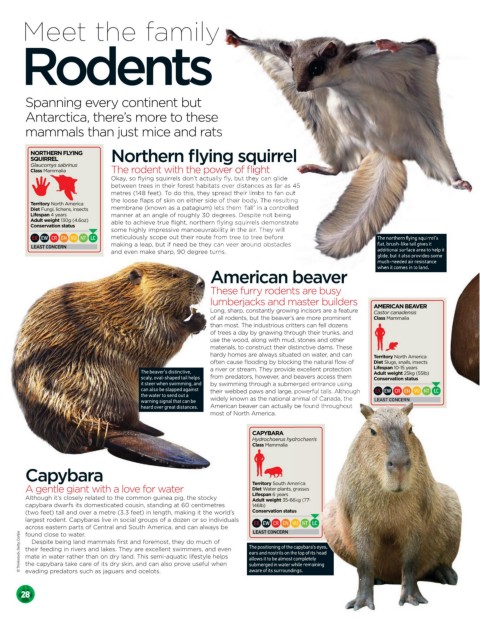
The rodent with the power of flight
Class Mammalia T h e r o de n t w i t h t h e p o w e r o f fl i g h t
Okay, so flying squirrels don’t actually fly, but they can glide
O k a y , s o fl y i n g s q u i r r e l s d o n ’ t a c t u a l l y fl y , b u t t h e y c a n g l i d e
between trees in their forest habitats over distances as far as 45
b e t w e e n t r e e s i n t h e i r f o r e s t h a b i t a t s o v e r d i s t a n c e s a s f a r a s 4 5
metres (148 feet). To do this, they spread their limbs to fan out
m e t r e s ( 1 4 8 f e e t ) . T o d o t h i s , t h e y s p r e a d t h e i r l i m b s t o f a n o u t
h
r b
i
s
f t
o
n o
i
g
k
o
e
o
p
i
n
h
i
a
t
n e
d
l
e o
e fl
r s
e
t
i
h
h
. T
e l
y
f s
s
u
t the loose flaps of skin on either side of their body. The resulting
e r
e
d
s o
Territory North America
i
u
m
n
o
w
m
e (
n
f
n
a
o
a
t
t
l
g
d
a
l
m
k
h
l
r
e
s a p
l
m ‘
’ i
n a
e
b
s t
e
a
) l
r
o
n a c
t
e
Diet Fungi, lichens, insects membrane (known as a patagium) lets them ‘fall’ in a controlled
e o
o
g
f r
l
u
s
p
i
n
. D
e
t b
e
i
t
e n
o
y 3
g
0 d
g
h
l
e
e
s
e
g
r
n
a
n
m
r a
n
e
t a
n a
Lifespan 4 years manner at an angle of roughly 30 degrees. Despite not being
Adult weight 130g (4.6oz) a able to achieve true flight, northern flying squirrels demonstrate
h
t
s
y
o a
e
g s
i
i
n
g
c
e
e
r
o
t
r
h
h
i
, n
n fl
a
t
t
r
r
l
e t
e t
e fl
r
o
e
s d
e
b
l
u
m
r
i
n
q
u
v
Conservation status
. T
r
h
r
g
n t
o
h
e
h
v
u
e
m
some highly impressive manoeuvrability in the air. They will l
t
l
y i
s
i
l
i
a
i
y w
e h
i
e a
b
i
o
m
r
l
n
e
y i
v
e m
a
i
s
s
p
r
u
r
e
e
r
r
c
c
h
h
m t
y s
o
o
l
y s
u
e
u
u
t t
m t
t t
e
e t
r
e
e
r
e
p
p
e
e b
e b
o
o
e
c
c
e
o t
t
o
o t
e t
i
i
o
f
f
m m
e o
meticulously scope out their route from tree to tree before T The northern flying squirrel’s
t
e o
o
i
r r
l
e
e
i
u
l
o
o
o
u
u
t
r
r
l
e f
s
e f
t
s
r r
u
r
t
y
q
s
o
n fl
’
h
e
l
r
h
r
n
i
e n
e
r
g s
i
u
m m
u
n
n
o
o
e t
e t
t
t
b
b
s
u
u
, b
, b
s
e
fl at, brush-like tail gives it
t i
a
h
u
a
t i
making a leap, but if need be they can veer around obstacles flat, brush-like tail gives it
h
e
k
e
l
l
g a l
c
c
e
n
n
e
e
e
d b
n v
n v
a
a
d b
a
g a l
e
a
e
e
f n
f n
e
d o
a
p
d o
y c
y c
k
r
r
e
s
p
i
e
e
s
r a
r a
i
a
LEAST CONCERN
a t
a
l s
n
f
a
i
r
d
e a
c
d
o
u
a
additional surface area to help it
r
t
e
i
o h
e
p i
l
e
h
n
n m
e t
s
d e
a
g
e
v
r
e
a
u
, 9
r
p
e s
k
n
0 d
r
a
and even make sharp, 90 degree turns. . additional surface area to help it t
, b
u
o p
r
e
t i
s
t a
v
l
o
i
l
o
d
g
glide, but it also provides some
glide, but it also provides some
s s
e
m
e
i
d
much-needed air resistance
much-needed air resistance
when it comes in to land.
when it comes in to land.
an b
an b
i
c
c
American beaver
i
A A
r
r
v
r
r
e
e
me
me
e
e
v
a
a
These furry rodents are busy
lumberjacks and master builders
Long, sharp, constantly growing incisors are a feature AMERICAN BEAVER
Castor canadensis
of all rodents, but the beaver’s are more prominent Class Mammalia
than most. The industrious critters can fell dozens
of trees a day by gnawing through their trunks, and
use the wood, along with mud, stones and other
materials, to construct their distinctive dams. These
hardy homes are always situated on water, and can Territory North America
often cause flooding by blocking the natural flow of Diet Slugs, snails, insects
The beaver’s distinctive, a river or stream. They provide excellent protection Lifespan 10-15 years
Adult weight 25kg (55lb)
scaly, oval-shaped tail helps from predators, however, and beavers access them Conservation status
d e
m
g t
u
e
i
w
r
m
t
n
i
n
c
a
n
h a s
r
b
h
o
u
m
g
b
r
i
s
e u
g
e
g
y s
n
it steer when swimming, and by swimming through a submerged entrance using
can also be slapped against t their webbed paws and large, powerful tails. Although
e
r
h
o
h
t
l
i
d l
u
w
n
s a
e
a
h
g
g
, p
a
u
a
e
r
b
b
e
f
i
. A
o
r w
l t
d p
s
e
l
w
the water to send out a w i d e l y k n o w n a s t h e n a t i o n a l a n i m a l o f C a n a d a , t h e
widely known as the national animal of Canada, the
LEAST CONCERN
warning signal that can be LEAST CONCERN
American beaver can actually be found throughout
heard over great distances. A m e r i c a n b e a v e r c a n a c t u a l l y b e f o u n d t h r o u g h o u t
most of North America.
CAPYBARA
Hy
ochoerus h
ochaeris
dr
Hydrochoerus hydrochaeris
y
dr
Class Mammalia
Capybara
South America
A gentle giant with a love for water Territory South America
Diet Water plants, grasses
Water plants, grasses
Although it’s closely related to the common guinea pig, the stocky Lifespan 6 years
35-66kg (77-
Adult weight 35-66kg (77-
capybara dwarfs its domesticated cousin, standing at 60 centimetres 146lb)
Conservation status
(two feet) tall and over a metre (3.3 feet) in length, making it the world’s Conservation status
largest rodent. Capybaras live in social groups of a dozen or so individuals
across eastern parts of Central and South America, and can always be LEAST CONCERN
found close to water.
© Thinkstock; Getty; Corbis their feeding in rivers and lakes. They are excellent swimmers, and even The positioning of the capybara’s eyes, ,
Despite being land mammals first and foremost, they do much of
n
i
n
a
e
y
g o
s
o
e p
i
o
i
t
e c
h
r
s
a
T
p
f t
b
h
y
a
’
s e
ears and nostrils on the top of its head
ears and nostrils on the top of its head
mate in water rather than on dry land. This semi-aquatic lifestyle helps
allows it to be almost completely
allows it to be almost completely
the capybara take care of its dry skin, and can also prove useful when
submerged in water while remaining
submerged in water while remaining
evading predators such as jaguars and ocelots.
aware of its surroundings.
aware of its surroundings.
28
028-029_Meet the family_WOA031.indd 28 02/03/2016 12:38

