


Page 29 - World of Animals - Issue #31
P. 29
Rodentia
NAKED MOLE RAT
NAKED MOLE RA T
Heterocephalus glaber
Het er oc ephalus glaber 2
Class Mammalia 1
3
Territory Eastern Africa 4
Eastern Africa
Diet Roots, tubers
Lifespan 30 years
Adult weight 30-80g (1.1-
30-80g (1.1-
2.8oz) Naked mole rat
Conservation status 1. Rarest 3. Most
Conservation status
. R
1
a
s
t
r
e
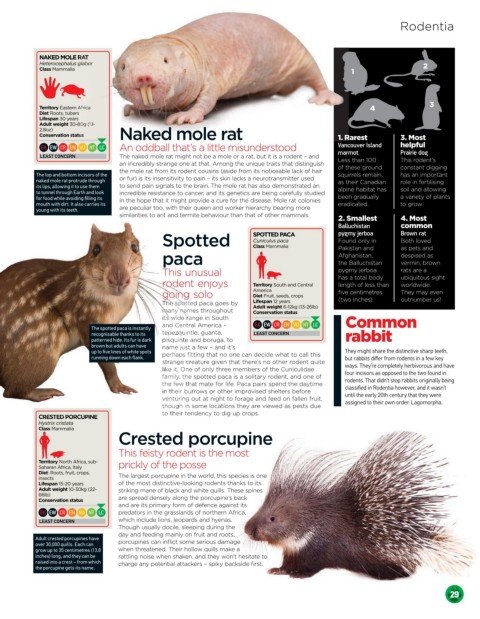
An oddball that’s a little misunderstood Vancouver Island helpful
LEAST CONCERN The naked mole rat might not be a mole or a rat, but it is a rodent – and marmot Prairie dog
Less than 100
This rodent’s
an incredibly strange one at that. Among the unique traits that distinguish of these ground constant digging
the mole rat from its rodent cousins (aside from its noticeable lack of hair
The top and bottom incisors of the or fur) is its insensitivity to pain – its skin lacks a neurotransmitter used squirrels remain, has an important
naked mole rat protrude through as their Canadian role in fertilising
its lips, allowing it to use them to send pain signals to the brain. The mole rat has also demonstrated an alpine habitat has soil and allowing
to tunnel through Earth and look incredible resistance to cancer, and its genetics are being carefully studied
for food while avoiding filling its in the hope that it might provide a cure for the disease. Mole rat colonies been gradually a variety of plants
mouth with dirt. It also carries its are peculiar too, with their queen and worker hierarchy bearing more eradicated. to grow.
young with its teeth.
similarities to ant and termite behaviour than that of other mammals. 2. Smallest 4. Most
Balluchistan common
S po t t ed SPOTTED PACA pygmy jerboa Brown rat
Spotted
Both loved
Found only in
Cuniculus paca
Class Mammalia
as pets and
Pakistan and
paca Afghanistan, despised as
paca
the Balluchistan
vermin, brown
a
us
n
u
s
This unusual pygmy jerboa rats are a
T
u
l
hi
rodent enjoys
rodent enjoys Territory South and Central has a total body ubiquitous sight
length of less than
worldwide.
going solo America fi ve centimetres They may even
going solo
Diet Fruit, seeds, crops
T h e s p o t t e d p a c a g o e s b y Lifespan 12 years (two inches). outnumber us!
The spotted paca goes by
Adult weight 6-12kg (13-26lb)
t
t
hr
u
am
e
s
n
an
many names throughout Conservation status
ho
g
y
m
o
u
i
s w
d
e r
u
o
h
t
n S
n
a
e i
g
its wide range in South Common
i
t
e
n
a
m
d C
a
r
l A
t
and Central America –
a –
c
r
e
i
n
The spotted paca is instantly
a
qu
n
t
i
,
gu
t
an
t
l
e
z
e
e
p
recognisable thanks to its tepezquintle, guanta, , LEAST CONCERN rabbit
pisquinte and boruga, to
patterned hide. Its fur is dark p i s qu i n t e an d b oru g a , t o
brown but adults can have n a m e j u s t a f e w – a n d i t ’ s
name just a few – and it’s
up to five lines of white spots p e r h a p s fi t t i n g t h a t n o o n e c a n d e c i d e w h a t t o c a l l t h i s They might share the distinctive sharp teeth,
perhaps fitting that no one can decide what to call this
running down each flank. but rabbits differ from rodents in a few key
r
e
u
t q
t
a
a
s
e
strange creature given that there’s no other rodent quite
e
t
e
t
i
v
e
i
n t
t t
e g
r
h
r
h
a
u
’
n
e
r r
g
s n
t
e
e c
o o
h
r
n
d
o
u
h
r
i
e C
m
t
n
e
k
i
y t
. O
u
e m
e
n
c
l
e
s o
e
l
e o
f t
i
f o
a
d
r
b
h
e i
like it. One of only three members of the Cuniculidae ways. They’re completely herbivorous and have
n
l
, a
n
n
f
a
t
i
a
o
e
n
o
d
s a s
e o
c
y r
r
d o
t
a i
l
i
o
l
t
d p
e
t
f
h
, t
e s
p
y
family, the spotted paca is a solitary rodent, and one of four incisors as opposed to the two found in
m
a
a p
s s
o
h
c
a
a
t
p
the few that mate for life. Paca pairs spend the daytime rodents. That didn’t stop rabbits originally being
r
e
e d
r l
a
h
e
i
h
a
t m
f
y
e f
t
d t
e
t
i
e f
n
w t
i
m
. P
e
a
e
t
r
s b
s
t
e
in their burrows or other improvised shelters before classified in Rodentia however, and it wasn’t
i
l
n t
i
d s
e
r b
h
u
f
h
r
w
o
r i
h
p
s o
r
m
o
r
e
e
r o
i
r
o
e
v
e
venturing out at night to forage and feed on fallen fruit,
v e n t u r i n g o u t a t n i g h t t o f o r a g e a n d f e e d o n f a l l e n f r u i t , until the early 20th century that they were
s d
o
h
t
e
though in some locations they are viewed as pests due assigned to their own order: Lagomorpha.
g
s p
t
u
u
s
e
e l
h
s t
e
o
m
y a
i
t
a
c
n
o
o
r
e
i
w
e v
d a
n s
e
h i
y t
to their tendency to dig up crops. .
t
o d
o t
i
g u
i
r t
p
o
n
e
d
s
e
e
c
p c
n
r
h
TED PORCUPINE
CRES
CRESTED PORCUPINE
Hystrix cristata
Class Mammalia
Crested porcupine
This feisty rodent is the most
Territory North Africa, sub- prickly of the posse
Saharan Africa, Italy
Diet: Roots, fruit, crops, The largest porcupine in the world, this species is one
insects
Lifespan 15-20 years of the most distinctive-looking rodents thanks to its
Adult weight 10-30kg (22- striking mane of black and white quills. These spines
66lb) are spread densely along the porcupine’s back
Conservation status
and are its primary form of defence against its
predators in the grasslands of northern Africa,
LEAST CONCERN which include lions, leopards and hyenas.
Though usually docile, sleeping during the
day and feeding mainly on fruit and roots,
Adult crested porcupines have porcupines can inflict some serious damage
over 30,000 quills. Each can
grow up to 35 centimetres (13.8 when threatened. Their hollow quills make a
inches) long, and they can be rattling noise when shaken, and they won’t hesitate to
raised into a crest – from which charge any potential attackers – spiky backside first.
the porcupine gets its name.
29
028-029_Meet the family_WOA031.indd 29 02/03/2016 12:38

