


Page 94 - World of Animals - Issue #31
P. 94
Animal


           answers


            Send your animal questions to us at:

            questions@animalanswers.co.uk


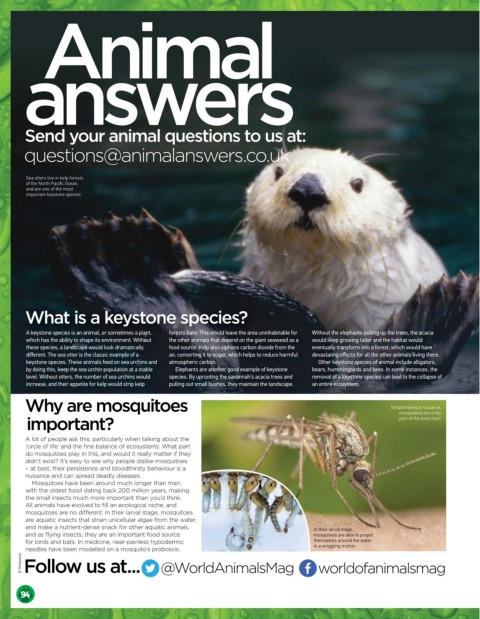
            Sea otters live in kelp forests
            of the North Pacifi c Ocean,
            and are one of the most
            important keystone species


            What is a keystone species?

            A keystone species is an animal, or sometimes a plant,   forests bare. This would leave the area uninhabitable for   Without the elephants pulling up the trees, the acacia
            which has the ability to shape its environment. Without   the other animals that depend on the giant seaweed as a   would keep growing taller and the habitat would
            these species, a landscape would look dramatically   food source. Kelp also siphons carbon dioxide from the   eventually transform into a forest, which would have
            different. The sea otter is the classic example of a   air, converting it to sugar, which helps to reduce harmful   devastating effects for all the other animals living there.


            keystone species. These animals feed on sea urchins and   atmospheric carbon.   Other keystone species of animal include alligators,
            by doing this, keep the sea urchin population at a stable   Elephants are another good example of keystone   bears, hummingbirds and bees. In some instances, the
            level. Without otters, the number of sea urchins would   species. By uprooting the savannah’s acacia trees and   removal of a keystone species can lead to the collapse of
            increase, and their appetite for kelp would strip kelp   pulling out small bushes, they maintain the landscape.   an entire ecosystem.
            Why are mosquitoes                                                                                  Despite being a nuisance,

                                                                                                                  mosquitoes are a key
            important?                                                                                            part of the food chain

            A lot of people ask this, particularly when talking about the
            ‘circle of life’ and the fine balance of ecosystems. What part

            do mosquitoes play in this, and would it really matter if they
            didn’t exist? It’s easy to see why people dislike mosquitoes
            – at best, their persistence and bloodthirsty behaviour is a
            nuisance and can spread deadly diseases.
              Mosquitoes have been around much longer than man,
            with the oldest fossil dating back 200 million years, making
            the small insects much more important than you’d think.

            All animals have evolved to fill an ecological niche, and
            mosquitoes are no different. In their larval stage, mosquitoes
            are aquatic insects that strain unicellular algae from the water,
            and make a nutrient-dense snack for other aquatic animals,                    In their larval stage,
            and as flying insects, they are an important food source                       mosquitoes are able to propel

            for birds and bats. In medicine, near-painless hypodermic                     themselves around the water
            needles have been modelled on a mosquito’s proboscis.                         in a wriggling motion
           © Thinkstock   Follow us at...        @WorldAnimalsMag                           worldofanimalsmag


           94 94


       094-095_WOA31_Animal Answers.indd   94                                                                                02/03/2016   17:08

