


Page 89 - World of Animals - Issue #31
P. 89
Wildlife photography


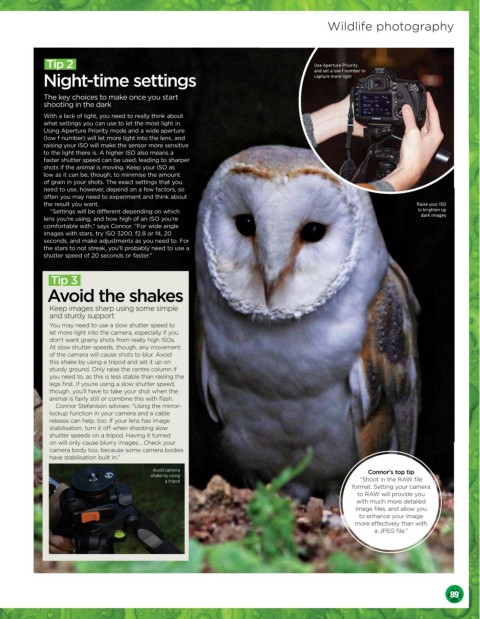
                  Tip 2                                                                    Use Aperture Priority
                                                                                           and set a low f number to
                 Night-time settings                                                       capture more light

                 The key choices to make once you start
                 shooting in the dark
                 With a lack of light, you need to really think about
                 what settings you can use to let the most light in.
                 Using Aperture Priority mode and a wide aperture
                 (low f number) will let more light into the lens, and
                 raising your ISO will make the sensor more sensitive
                 to the light there is. A higher ISO also means a
                 faster shutter speed can be used, leading to sharper
                 shots if the animal is moving. Keep your ISO as
                 low as it can be, though, to minimise the amount
                 of grain in your shots. The exact settings that you
                 need to use, however, depend on a few factors, so
                 often you may need to experiment and think about
                 the result you want.                                                                                  Raise your ISO
                   “Settings will be different depending on which                                                      to brighten up
                 lens you’re using, and how high of an ISO you’re                                                       dark images
                 comfortable with,” says Connor. “For wide angle
                 images with stars, try ISO 3200, f2.8 or f4, 20
                 seconds, and make adjustments as you need to. For
                 the stars to not streak, you’ll probably need to use a
                 shutter speed of 20 seconds or faster.”


                   Tip 3
                  Avoid the shakes

                   Keep images sharp using some simple
                   and sturdy support
                   You may need to use a slow shutter speed to
                   let more light into the camera, especially if you
                   don’t want grainy shots from really high ISOs.
                   At slow shutter speeds, though, any movement
                   of the camera will cause shots to blur. Avoid
                   this shake by using a tripod and set it up on
                   sturdy ground. Only raise the centre column if
                   you need to, as this is less stable than raising the

                   legs first. If you’re using a slow shutter speed,
                   though, you’ll have to take your shot when the

                   animal is fairly still or combine this with flash.
                    Connor Stefanison advises: “Using the mirror-
                   lockup function in your camera and a cable
                   release can help, too. If your lens has image
                   stabilisation, turn it off when shooting slow
                   shutter speeds on a tripod. Having it turned
                   on will only cause blurry images… Check your
                   camera body too, because some camera bodies
                   have stabilisation built in.”

                                               Avoid camera                                              Connor’s top tip
                                              shake by using

                                                  a tripod                                             “Shoot in the RAW file
                                                                                                     format. Setting your camera
                                                                                                      to RAW will provide you
                                                                                                      with much more detailed

                                                                                                      image files, and allow you
                                                                                                       to enhance your image
                                                                                                      more effectively than with

                                                                                                           a JPEG file.”


                                                                                                                               89 89


       088-091_WOA31_Nighttime photography.indd   89                                                                         02/03/2016   17:04

