


Page 90 - World of Animals - Issue #31
P. 90
Wildlife photography


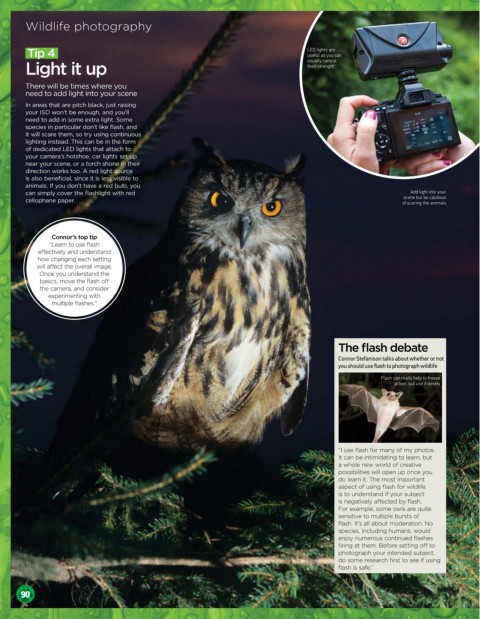
             Tip 4                                                                       LED lights are
                                                                                         useful as you can
            Light it up                                                                  usually control
                                                                                         their strength

            There will be times where you
            need to add light into your scene
            In areas that are pitch black, just raising
            your ISO won’t be enough, and you’ll
            need to add in some extra light. Some

            species in particular don’t like flash, and
            it will scare them, so try using continuous
            lighting instead. This can be in the form
            of dedicated LED lights that attach to
            your camera’s hotshoe, car lights set up
            near your scene, or a torch shone in their
            direction works too. A red light source

            is also beneficial, since it is less visible to
            animals. If you don’t have a red bulb, you

            can simply cover the flashlight with red                                                                  Add light into your
                                                                                                                   scene but be cautious
            cellophane paper.                                                                                      of scaring the animals


                   Connor’s top tip

                  “Learn to use flash
               effectively and understand
               how changing each setting
               will affect the overall image.
                Once you understand the

                basics, move the flash off
                the camera, and consider
                  experimenting with
                   multiple fl ashes.”


                                                                                                 The flash debate

                                                                                                 Connor Stefanison talks about whether or not

                                                                                                 you should use flash to photograph wildlife
                                                                                                             Flash can really help to freeze
                                                                                                                action, but use it wisely


                                                                                                 “I use flash for many of my photos.
                                                                                                 It can be intimidating to learn, but
                                                                                                 a whole new world of creative
                                                                                                 possibilities will open up once you
                                                                                                 do learn it. The most important

                                                                                                 aspect of using flash for wildlife
                                                                                                 is to understand if your subject
                                                                                                 is negatively affected by flash.

                                                                                                 For example, some owls are quite
                                                                                                 sensitive to multiple bursts of

                                                                                                 flash. It’s all about moderation. No
                                                                                                 species, including humans, would
                                                                                                 enjoy numerous continued flashes


                                                                                                 firing at them. Before setting off to
                                                                                                 photograph your intended subject,

                                                                                                 do some research first to see if using
                                                                                                 flash is safe.”

           90


       088-091_WOA31_Nighttime photography.indd   90                                                                         02/03/2016   17:04

