


Page 100 - (DK Eyewitness) Travel Guide - Sicily
P. 100
98 SICIL Y AREA B Y AREA
0 Caccamo
Road map C2. * 8,500. @ 48 km
(30 miles) from Palermo. n Town
hall, Piazza Duomo (091-810 32 07).
( Sat.
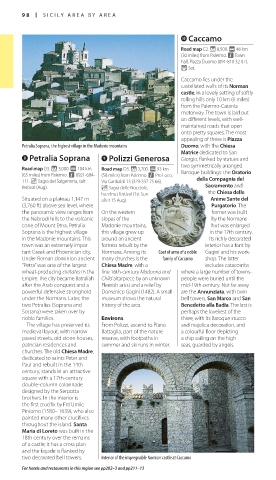
Caccamo lies under the
castellated walls of its Norman
castle, in a lovely setting of softly
rolling hills only 10 km (6 miles)
from the Palermo-Catania
motorway. The town is laid out
on different levels, with well-
maintained roads that open
onto pretty squares. The most
appealing of these is Piazza
Petralia Soprana, the highest village in the Madonie mountains Duomo, with the Chiesa
Matrice dedicated to San
8 Petralia Soprana 9 Polizzi Generosa Giorgio, flanked by statues and
two symmetrically arranged
Road map D3. * 3,000. @ 104 km Road map D3. * 3,700. @ 93 km
(65 miles) from Palermo. n 0921-684- (58 miles) from Palermo. n Pro Loco, Baroque buildings: the Oratorio
111. _ Sagra del Salgemma, salt Via Garibaldi 13 (329-337 75 66). della Compagnia del
festival (Aug). _ Sagra delle Nocciole, Sacramento and
hazelnut festival (1st Sun the Chiesa delle
Situated on a plateau 1,147 m after 15 Aug). Anime Sante del
(3,760 ft) above sea level, where Purgatorio. The
the panoramic view ranges from On the western former was built
the Nebrodi hills to the volcanic slopes of the by the Normans
cone of Mount Etna, Petralia Madonie mountains, but was enlarged
Soprana is the highest village this village grew up in the 17th cen tury.
in the Madonie mountains. This around an ancient Its richly decorated
town was an extremely impor- fortress rebuilt by the interior has a font by
tant Greek and Phoenician city. Normans. Among its Coat of arms of a noble Gagini and his work-
Under Roman dominion ancient many churches is the family of Caccamo shop. The latter
“Petra” was one of the largest Chiesa Madre, with a includes catacombs
wheat-producing civitates in the fine 16th-century Madonna and where a large number of towns-
Empire. The city became Batraliah Child altarpiece by an unknown people were buried until the
after the Arab conquest and a Flemish artist and a relief by mid-19th century. Not far away
powerful defensive stronghold Domenico Gagini (1482). A small are the Annunziata, with twin
under the Normans. Later, the museum shows the natural bell towers, San Marco and San
two Petralias (Soprana and history of the area. Benedetto alla Badia. The last is
Sottana) were taken over by perhaps the loveliest of the
noble families. Environs three, with its Baroque stucco
The village has preserved its From Polizzi, ascend to Piano and majolica decoration, and
medieval layout, with narrow Battaglia, part of the nature a colourful floor depicting
paved streets, old stone houses, reserve, with footpaths in a ship sailing on the high
patrician residences and summer and ski runs in winter. seas, guarded by angels.
churches. The old Chiesa Madre,
dedicated to saints Peter and
Paul and rebuilt in the 14th
century, stands in an attractive
square with a 17th-century
double-column colonnade
designed by the Serpotta
brothers. In the interior is
the first crucifix by Fra’ Umile
Pintorno (1580– 1639), who also
painted many other crucifixes
throughout the island. Santa
Maria di Loreto was built in the
18th century over the remains
of a castle; it has a cross plan
and the façade is flanked by
two decorated bell towers. Interior of the impregnable Norman castle at Caccamo
For hotels and restaurants in this region see pp202–3 and pp211–13
098-099_EW_Sicily.indd 98 11/3/16 2:09 PM
Eyewitness Travel LAYERS PRINTED:
Catalogue template “UK” LAYER
(Source v2.6)
Date 12th July 2013
Size 125mm x 217mm

