


Page 97 - (DK Eyewitness) Travel Guide - Sicily
P. 97
NOR THWESTERN SICIL Y 95
access to the town. It leads to 2 Castel di Tusa
the colourful fishermen’s quarter, Road map D2. * 3,900. V 892 021.
where scenes were shot for the n 0921-330 405.
film Cinema Paradiso (see p124).
This beautiful swimming resort
P La Rocca is dominated by the ruins of a
From Piazza Garibaldi a path 14th-century castle. The
halfway up the hill offers a fine characteristic alleys with old
view of the old town and the stone houses and villas
sea and leads to the ruins of the converge in the central square,
fortifications (most probably which is paved with stone. To
Byzantine) and the prehistoric get to the little port you must
sanctuary known as the Tempio go under the railway arches.
di Diana, a 5th–4th century BC The banks of the nearby Tusa
megalithic construction with river have been turned into an
Antonello da Messina, Portrait of an a cistern dating from the outdoor gallery with works by
Unknown Man (1465) 9th century AD. On the top of contemporary artists, inclu ding
the Rocca are the ruins of a sculptor Pietro Consagra. Only
Archaeological jewels include 12th–13th-century castle. a few miles away are the Ruins
a late Hellenistic mosaic and a of Halaesa Arconidea.
4th-century BC krater with Environs
a figure of a tuna fish cutter. On the slopes of Pizzo Sant’ T Ruins of Halaesa
A curiosity exhibit is the Angelo is the Santuario di Arconidea
collection of patience (solitaire) Gibilmanna, a sanctuary built 3 km (2 miles) on the road to Tusa.
playing cards made out of in the 17th and 18th Tel 0921-334 531. Open summer:
precious materials. centuries and the 9am–7:30pm; winter: 9am–4:30pm.
most popular On a hill covered with olive
P Via Vittorio Emanuele pilgrimage site in Sicily. trees and asphodels are
This street runs along the The former convent the ruins of the city of
seafront, separated by a row of stables house the Halaesa Arconidea, a
medieval houses facing the bay. Museo dell’ Ordine, Greek colony founded
Under one of these is the famous the museum of the in 403 BC, which
Lavatoio, the stone fountain Capuchin friars, with prospered until it
known as U’ Ciumi, or river, paintings, sculpture was sacked by the
which was mentioned by the and vestments. The Roman praetor Verres.
medieval writer Boccaccio and most interesting Excavations have
was used for washing clothes pieces are crêche A 16th-century statuette, started and you can
until a few years ago. A stairway figures, enamelled Santuario di Gibilmanna see the Agora, remains
leads to the basin where water reliquaries, a of cyclopean walls and
gushes from holes on three 16th-century alabaster rosary, a Hellenistic temple. Near the
walls. The lovely Porta Marina is and a white marble Pietà by the archaeo logical site is the
the only remaining city gate of local sculptor Jacopo Lo Duca, Monastery of Santa Maria
the four that once afforded a pupil of Michelangelo. della Balate.
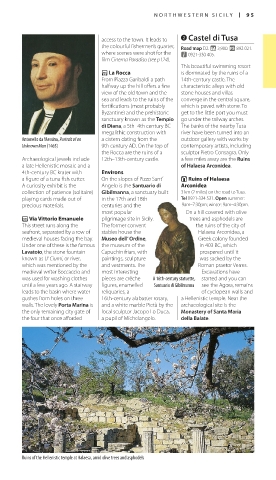
Ruins of the Hellenistic temple at Halaesa, amid olive trees and asphodels
094-095_EW_Sicily.indd 95 11/3/16 2:09 PM

