


Page 101 - (DK Eyewitness) Travel Guide - Sicily
P. 101
NOR THWESTERN SICIL Y 99
later almost destroyed by the
Saracens. At the entrance there
is a museum displaying a site
plan and finds from the various
digs, which began in 1826 and
are still under way.
Solunto follows a traditional
layout. The path leading to the
site takes you to Via dell’Agorà,
with a fired-brick pavement and
gutters for drainage. This street
makes a right angle with the
side stairs, which mark off the
blocks of buildings (insulae).
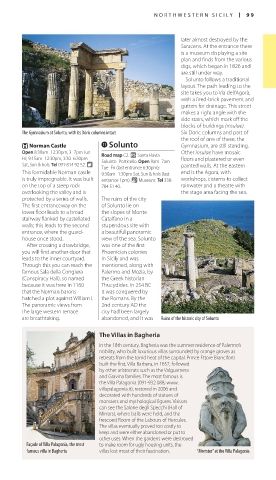
The Gymnasium at Solunto, with its Doric columns intact Six Doric columns and part of
the roof of one of these, the
+ Norman Castle q Solunto Gymna sium, are still standing.
Open 8:30am–12:30pm, 3–7pm Tue– Road map C2. V Santa Flavia– Other insulae have mosaic
Fri; 9:15am–12:30pm, 3:30–6:30pm Solunto–Porticello. Open 9am–7am floors and plastered or even
Sat, Sun & hols. Tel 091-814 92 52. 8 Tue–Fri (last entrance 6:30pm); painted walls. At the eastern
This formidable Norman castle 9:30am–1:30pm Sat, Sun & hols (last end is the Agora, with
is truly impregnable. It was built entrance 1pm). & Museum: Tel 338- workshops, cisterns to collect
on the top of a steep rock 784 51 40. rainwater and a theatre with
overlooking the valley and is the stage area facing the sea.
protected by a series of walls. The ruins of the city
The first entranceway on the of Solunto lie on
lower floor leads to a broad the slopes of Monte
stairway flanked by castellated Catalfano in a
walls; this leads to the second stupendous site with
entrance, where the guard- a beautiful panoramic
house once stood. view of the sea. Solunto
After crossing a drawbridge, was one of the first
you will find another door that Phoenician colonies
leads to the inner courtyard. in Sicily and was
Through this you can reach the mentioned, along with
famous Sala della Con giura Palermo and Mozia, by
(Conspiracy Hall), so named the Greek historian
because it was here in 1160 Thucydides. In 254 BC
that the Norman barons it was conquered by
hatched a plot against William I. the Romans. By the
The panoramic views from 2nd century AD the
the large western terrace city had been largely
are breathtaking. abandoned, and it was Ruins of the historic city of Solunto
The Villas in Bagheria
In the 18th century, Bagheria was the summer residence of Palermo’s
nobility, who built luxurious villas surrounded by orange groves as
retreats from the torrid heat of the capital. Prince Ettore Branciforti
built the first, Villa Barbera, in 1657, followed
by other aristocrats such as the Valguarnera
and Gravina families. The most famous is
the Villa Palagonia (091-932 088; www.
villapalagonia.it), restored in 2006 and
decorated with hundreds of statues of
monsters and mythological figures. Visitors
can see the Salone degli Specchi (Hall of
Mirrors), where balls were held, and the
frescoed Room of the Labours of Hercules.
The villas eventually proved too costly to
keep and were either abandoned or put to
other uses. When the gardens were destroyed
Façade of Villa Palagonia, the most to make room for ugly housing units, the
famous villa in Bagheria villas lost most of their fascination. “Monster” at the Villa Palagonia
098-099_EW_Sicily.indd 99 11/3/16 2:09 PM

