


Page 171 - (DK Eyewitness) Travel Guide - Sicily
P. 171
NOR THEASTERN SICIL Y 169
After collapsing in the 1693
earthquake, the church was
rebuilt in the 1700s. It now
houses the faculty of letters
of the University of Catania.
The nave has two aisles,
separated from the central
section by huge piers. In the
transept is one of the largest
sundials in Europe, restored in
1996. It was built in the mid-
1800s by the German baron
Wolfgang Sartorius von
Castello Ursino, one of the rare medieval buildings in Catania Waltershausen and is extremely
precise. Twenty-four slabs of
a massive defence system Catania. The library in Verga’s inlaid marble show the signs of
that once included the Motta, house boasts over 2,500 books the zodiac, days of the year and
Anastasia, Paternò and Adrano from the author’s collection, the seasons. At noon, sunlight
castles. Castello Ursino ranging from works by the falls on the spot from an
is square, with four corner Italian Futurist Marinetti to the opening in the roof, marking
towers, and was rebuilt in the Russian author Dostoevsky. the day and month.
mid-1500s. On the eastern side The bedroom is quite simple,
of its exterior, above a large with a bed, a dressing table, P Via Etnea
window, a five-pointed star with a wardrobe and portraits of Catania’s main street goes up a
a cabalistic meaning is visible. Verga painted by his grandson slight incline and connects the
In a niche on the façade, the Michele Grita. most important parts of the city.
Swabian eagle seizing a lamb Partly closed to traffic, Via Etnea
with its claws is the symbol has the most elegant shops and
of Hohenstaufen imperial cafés in town. Half way along it
power. In the inner courtyard, lies Piazza Stesicoro, with the
where the kings of Aragon ruins of the Roman amphi-
administered justice, there is a theatre, built in the 2nd century
display of sarcophagi, columns AD. Nearby is the vast Piazza
and other pieces. Carlo Alberto, occupied from
The upper rooms house Monday to Saturday by Catania’s
the interesting Museo Civico, huge central market. Back on
which has a fine art gallery with Via Etnea is the Collegiata, a
impor tant works such as The chapel built in the early 1700s
Last Judgement by Beato San Nicolò, intended to be the largest and one of the most important
Angelico, The Last Supper by church in Sicily late Baroque works in the city.
the Spanish painter Luis de The concave façade, designed
Morales, St John the Baptist by R San Nicolò l’Arena by Stefano Ittar, is enlivened by
Pietro Novelli (see p27) and Piazza Dante. Tel 095-715 99 12. columns, statues and niches.
a dismantled polyptych by Open 9am–1pm daily. Near the end of Via Etnea is the
Antonello Saliba of the San Nicolò was built on the site Villa Bellini, a public garden
Madonna and Child taken from of a Benedictine monastery with subtropical plants and
Santa Maria del Gesù. damaged in the 1669 erup tion. busts of famous Sicilians.
E Museo Verga
Via Sant’Anna 8. Tel 095-715 05 98.
Open 9am–1pm, 2–7pm Mon–
Sat. &
The apartment where the great
Sicilian author Giovanni Verga
lived for many years and died
in 1922 is on the second floor
of a 19th-century building.
The house contains period
furniture and personal
mementos. At the entrance
are displayed reproduct ions
of manuscripts, the originals
of which are at the Biblioteca
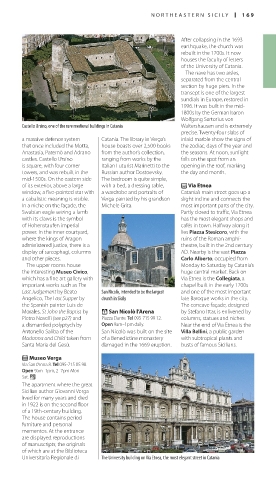
Universitaria Regionale di The University building on Via Etnea, the most elegant street in Catania
168-169_EW_Sicily.indd 169 11/3/16 2:07 PM

