


Page 173 - (DK Eyewitness) Travel Guide - Sicily
P. 173
NOR THEASTERN SICIL Y 171
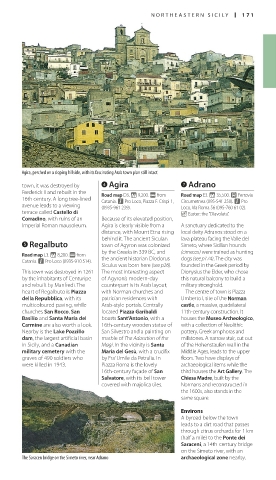
Agira, perched on a sloping hillside, with its fascinating Arab town plan still intact
town, it was destroyed by 6 Agira 7 Adrano
Frederick II and rebuilt in the Road map D3. * 9,200. @ from Road map E3. * 35,500. £ Ferrovia
16th century. A long tree-lined Catania. n Pro Loco, Piazza F. Crispi 1, Circumetnea (095-541 250). n Pro
avenue leads to a viewing (0935-961 239). Loco, Via Roma 56 (095-760 61 02).
terrace called Castello di _ Easter: the ”Diavolata”.
Corradino, with ruins of an Because of its elevated position,
Imperial Roman mausoleum. Agira is clearly visible from a A sanctuary dedicated to the
distance, with Mount Etna rising local deity Adranos stood on a
behind it. The ancient Siculan lava plateau facing the Valle del
5 Regalbuto town of Agyron was colonized Simeto, where Sicilian hounds
by the Greeks in 339 BC, and (cirnecos) were trained as hunting
Road map E3. * 8,200. @ from
Catania. n Pro Loco (0935-910 514). the ancient historian Diodorus dogs (see p174). The city was
Siculus was born here (see p26). founded in the Greek period by
This town was destroyed in 1261 The most interesting aspect Dionysius the Elder, who chose
by the inhabitants of Centuripe of Agyron’s modern-day this natural balcony to build a
and rebuilt by Manfredi. The counterpart is its Arab layout, military stronghold.
heart of Regalbuto is Piazza with Norman churches and The centre of town is Piazza
della Repub blica, with its patrician residences with Umberto I, site of the Norman
multi coloured paving, while Arab-style portals. Centrally castle, a massive, quadrilateral
churches San Rocco, San located Piazza Garibaldi 11th-century construction. It
Basilio and Santa Maria del boasts Sant’Antonio, with a houses the Museo Archeologico,
Carmine are also worth a look. 16th-century wooden statue of with a collection of Neolithic
Nearby is the Lake Pozzillo San Silvestro and a painting on pottery, Greek amph oras and
dam, the largest artificial basin marble of The Adoration of the millstones. A narrow stair, cut out
in Sicily, and a Canadian Magi. In the vicinity is Santa of the Hohenstaufen wall in the
military cemetery with the Maria del Gesù, with a crucifix Middle Ages, leads to the upper
graves of 490 soldiers who by Fra’ Umile da Petralia. In floors. Two have displays of
were killed in 1943. Piazza Roma is the lovely archaeological items while the
16th-century façade of San third houses the Art Gallery. The
Salvatore, with its bell tower Chiesa Madre, built by the
covered with majolica tiles. Normans and reconstructed in
the 1600s, also stands in the
same square.
Environs
Key A byroad below the town
leads to a dirt road that passes
Major road
through citrus orchards for 1 km
Ferrovia Circumetnea (half a mile) to the Ponte dei
Other roads Saraceni, a 14th-century bridge
River on the Simeto river, with an
The Saracen bridge on the Simeto river, near Adrano archaeological zone nearby.
170-171_EW_Sicily.indd 171 11/3/16 2:10 PM

