


Page 78 - (DK Eyewitness) Travel Guide - Sicily
P. 78
76 P ALERMO AREA B Y AREA
Most of the park is occupied
by sports facilities (tennis
courts, pools, a stadium and
racetrack). On the edge of the
park there are many villas built
in the 18th century as summer
residences for the Sicilian
nobility. The most interesting
are the Villa Sofia, now a
hospital; Villa Castelnuovo, an
agricultural institute; and Villa
Niscemi, mentioned in di
Lampedusa’s novel The Leopard
(see p27), now the venue for
cultural activities.
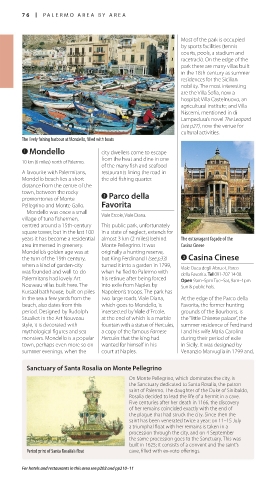
The lively fishing harbour at Mondello, filled with boats
1 Mondello city dwellers come to escape
from the heat and dine in one
10 km (6 miles) north of Palermo.
of the many fish and seafood
A favourite with Palermitans, restaurants lining the road in
Mondello beach lies a short the old fishing quarter.
distance from the centre of the
town, between the rocky 2 Parco della
promontories of Monte
Pellegrino and Monte Gallo. Favorita
Mondello was once a small Viale Ercole, Viale Diana.
village of tuna fishermen,
centred around a 15th-century This public park, unfortunately
square tower, but in the last 100 in a state of neglect, extends for
years it has become a residential almost 3 km (2 miles) behind The extravagant façade of the
area immersed in greenery. Monte Pellegrino. It was Casina Cinese
Mondello’s golden age was at originally a hunting reserve,
the turn of the 19th century, but King Ferdinand I (see p33) 3 Casina Cinese
when a kind of garden-city turned it into a garden in 1799, Viale Duca degli Abruzzi, Parco
was founded and well-to-do when he fled to Palermo with della Favorita. Tel 091-707 14 08.
Palermitans had lovely Art his retinue after being forced Open 9am–5pm Tue–Sat, 9am–1pm
Nouveau villas built here. The into exile from Naples by Sun & public hols.
Kursaal bathhouse, built on piles Napoleon’s troops. The park has
in the sea a few yards from the two large roads. Viale Diana, At the edge of the Parco della
beach, also dates from this which goes to Mondello, is Favorita, the former hunting
period. Designed by Rudolph intersected by Viale d’Ercole, grounds of the Bourbons, is
Stualket in the Art Nouveau at the end of which is a marble the “little Chinese palace”, the
style, it is decorated with fountain with a statue of Hercules, summer residence of Ferdinand
mythological figures and sea a copy of the famous Farnese I and his wife Maria Carolina
monsters. Mondello is a popular Hercules that the king had during their period of exile
town, perhaps even more so on wanted for himself in his in Sicily. It was designed by
summer evenings, when the court at Naples. Venanzio Marvuglia in 1799 and,
Sanctuary of Santa Rosalia on Monte Pellegrino
On Monte Pellegrino, which dominates the city, is
the Sanctuary dedicated to Santa Rosalia, the patron
saint of Palermo. The daughter of the Duke of Sinibaldo,
Rosalia decided to lead the life of a hermit in a cave.
Five centuries after her death in 1166, the discovery
of her remains coincided exactly with the end of
the plague that had struck the city. Since then the
saint has been venerated twice a year: on 11–15 July
a triumphal float with her remains is taken in a
procession through the city, and on 4 September
the same procession goes to the Sanctuary. This was
built in 1625; it consists of a convent and the saint’s
Period print of Santa Rosalia’s float cave, filled with ex-voto offerings.
For hotels and restaurants in this area see p202 and pp210–11
076-077_EW_Sicily.indd 76 11/3/16 2:09 PM
Eyewitness Travel LAYERS PRINTED:
Catalogue template “UK” LAYER
(Source v2.6)
Date 12th July 2013
Size 125mm x 217mm

