


Page 79 - (DK Eyewitness) Travel Guide - Sicily
P. 79
FUR THER AFIELD 77
it seems, the king himself had a
hand in the palace’s Oriental
architecture, which was much in
vogue at the time. Ferdinand I
entertained such illustrious
guests as Horatio Nelson and
his wife, Lady Hamilton, here.
The Casina Cinese was the
first example of eclectic
architecture in Palermo, a
combination of Chinese
decorative motifs and Gothic,
Egyptian and Arab elements.
Overall it is an extravagant work,
exemplified by details such as
the repetition of bells in the
shape of a pagoda on the fence,
the cornices and the roof. The
interior is equally flamboyant:
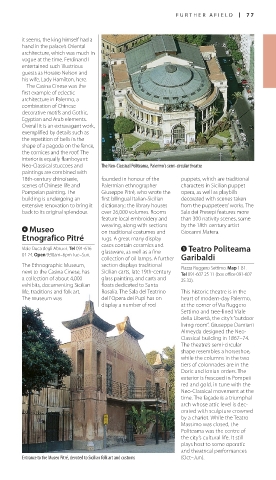
Neo-Classical stuccoes and The Neo-Classical Politeama, Palermo's semi-circular theatre
paintings are combined with
18th-century chinoiserie, founded in honour of the puppets, which are traditional
scenes of Chinese life and Palermian ethnographer characters in Sicilian puppet
Pompeian painting. The Giuseppe Pitré, who wrote the opera, as well as playbills
building is undergoing an first bilingual Italian-Sicilian decorated with scenes taken
extensive renovation to bring it dictionary; the library houses from the puppeteers’ works. The
back to its original splendour. over 26,000 volumes. Rooms Sala dei Presepi features more
feature local embroidery and than 300 nativity scenes, some
4 Museo weaving, along with sections by the 18th-century artist
Giocanni Matera.
on traditional costumes and
Etnografico Pitré rugs. A great many display
cases contain ceramics and
Viale Duca degli Abruzzi. Tel 091-616 5 Teatro Politeama
01 24. Open 9:30am–6pm Tue–Sun. glassware, as well as a fine
collection of oil lamps. A further Garibaldi
The Ethnographic Museum, section displays traditional Piazza Ruggero Settimo. Map 1 B1.
next to the Casina Cinese, has Sicilian carts, late 19th-century Tel 091-607 25 11 (box office 091-607
a collection of about 4,000 glass painting, and carts and 25 32).
exhibits, documenting Sicilian floats dedicated to Santa
life, traditions and folk art. Rosalia. The Sala del Teatrino This historic theatre is in the
The museum was dell’ Opera dei Pupi has on heart of modern-day Palermo,
display a number of rod at the corner of Via Ruggero
Settimo and tree-lined Viale
della Libertà, the city’s “outdoor
living room”. Giuseppe Damiani
Almeyda designed the Neo-
Classical building in 1867–74.
The theatre’s semi-circular
shape resembles a horseshoe,
while the columns in the two
tiers of colonnades are in the
Doric and Ionian orders. The
exterior is frescoed in Pompeii
red and gold, in tune with the
Neo-Classical movement at the
time. The façade is a triumphal
arch whose attic level is dec-
orated with sculpture crowned
by a chariot. While the Teatro
Massimo was closed, the
Politeama was the centre of
the city’s cultural life. It still
plays host to some operatic
and theatrical performances
Entrance to the Museo Pitré, devoted to Sicilian folk art and customs (Oct–Jun).
076-077_EW_Sicily.indd 77 11/3/16 2:09 PM

