


Page 167 - (DK Eyewitness) Travel Guide - Europe
P. 167
P ARIS 165
The formal gardens that line
the Champs-Elysées from
Place de la Concorde to the
Rond-Point have changed
little since they were laid out
by architect Jacques Hittorff
in 1838, and were used as
the setting for the 1855
World’s Fair. The Grand Palais
and the Petit Palais were also
built here for the Universal
Exhibition of 1900.
The exterior of the massive
Grand Palais combines an
imposing Neoclassical facade
with Art Nouveau ironwork. A
splendid glass roof is decorated
with colossal bronze statues of
flying horses and chariots at its
four corners. Inside is a science
exhibition (Le Palais de la
Découverte) and the Galeries
Nationales du Grand Palais,
which holds frequent
temporary exhibitions.
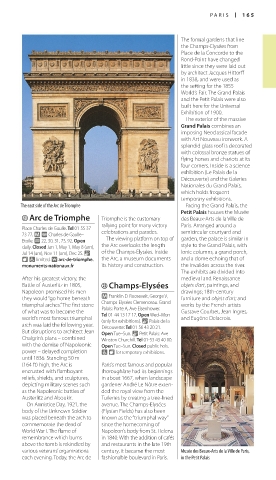
The east side of the Arc de Triomphe Facing the Grand Palais, the
Petit Palais houses the Musée
a Arc de Triomphe Triomphe is the customary des Beaux-Arts de la Ville de
rallying point for many victory Paris. Arranged around a
Place Charles de Gaulle. Tel 01-55 37
73 77. q W Charles de Gaulle– celebrations and parades. semicircular courtyard and
Etoile. @ 22, 30, 31, 73, 92. Open The viewing platform on top of garden, the palace is similar in
daily. Closed Jan 1, May 1, May 8 (am), the Arc overlooks the length style to the Grand Palais, with
Jul 14 (am), Nov 11 (am), Dec 25. & of the Champs-Elysées. Inside Ionic columns, a grand porch,
8 7 limited. ∑ arc-de-triomphe. the Arc, a museum documents and a dome echoing that of
monuments-nationaux.fr its history and construction. the Invalides across the river.
The exhibits are divided into
After his greatest victory, the medieval and Renaissance
Battle of Austerlitz in 1805, s Champs-Elysées objets d’art, paintings, and
Napoleon promised his men drawings; 18th-century
they would “go home beneath q Franklin D. Roosevelt, George V, furniture and objets d’art; and
Champs-Elysées Clemenceau. Grand
triumphal arches.” The first stone Palais: Porte A, Ave Eisenhower. works by the French artists
of what was to become the Tel 01-44 13 17 17. Open Wed–Mon Gustave Courbet, Jean Ingres,
world’s most famous triumphal (only for exhibitions). & Palais de la and Eugène Delacroix.
arch was laid the following year. Découverte: Tel 01-56 43 20 21.
But disruptions to architect Jean Open Tue–Sun. & Petit Palais: Ave
Chalgrin’s plans – combined Winston Churchill. Tel 01-53 43 40 00.
with the demise of Napoleonic Open Tue–Sun. Closed public hols.
power – delayed completion 7 8 for temporary exhibitions.
until 1836. Standing 50 m
(164 ft) high, the Arc is Paris’s most famous and popular
encrusted with flamboyant thoroughfare had its beginnings
reliefs, shields, and sculptures, in about 1667, when landscape
depicting military scenes such gardener André Le Nôtre exten-
as the Napoleonic battles of ded the royal view from the
Austerlitz and Aboukir. Tuile ries by creating a tree-lined
On Armistice Day, 1921, the avenue. The Champs-Elysées
body of the Unknown Soldier (Elysian Fields) has also been
was placed beneath the arch to known as the “triumphal way”
commemorate the dead of since the homecoming of
World War I. The flame of Napoleon’s body from St. Helena
remembrance which burns in 1840. With the addition of cafés
above the tomb is rekindled by and restaurants in the late 19th
various veterans’ organizations century, it became the most Musée des Beaux-Arts de la Ville de Paris,
each evening. Today, the Arc de fashionable boulevard in Paris. in the Petit Palais
164-165_EW_Europe.indd 165 14/07/16 10:14 am

