


Page 170 - (DK Eyewitness) Travel Guide - Europe
P. 170
168 FR ANCE AND THE L OW C OUNTRIES
k Château de Versailles
Visitors passing through the dazzling state rooms of this
colossal palace, or strolling in its vast gardens, will soon
understand why it was the glory of the Sun King’s reign.
Started by Louis XIV in 1668, the palace grew from a modest
hunting lodge built for his father, Louis XIII, to become the
largest palace in Europe, housing some 20,000 people.
Architect Louis Le Vau built the first section, which expanded
into an enlarged courtyard. From 1678, Jules Hardouin-
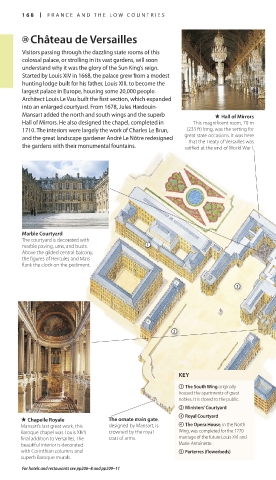
Mansart added the north and south wings and the superb . Hall of Mirrors
Hall of Mirrors. He also designed the chapel, completed in This magnificent room, 70 m
1710. The interiors were largely the work of Charles Le Brun, (233 ft) long, was the setting for
and the great landscape gardener André Le Nôtre redesigned great state occasions. It was here
that the Treaty of Versailles was
the gardens with their monumental fountains. ratified at the end of World War I.
Marble Courtyard
The courtyard is decorated with
marble paving, urns, and busts.
Above the gilded central balcony,
the figures of Hercules and Mars
flank the clock on the pediment.
KEY
1 The South Wing originally
housed the apartments of great
nobles. It is closed to the public.
2 Ministers’ Courtyard
. Chapelle Royale The ornate main gate, 3 Royal Courtyard
Mansart’s last great work, this designed by Mansart, is 4 The Opera House, in the North
Baroque chapel was Louis XIV’s crowned by the royal Wing, was completed for the 1770
final addition to Versailles. The coat of arms. marriage of the future Louis XVI and
beautiful interior is decorated Marie-Antoinette.
with Corinthian columns and 5 Parterres (flowerbeds)
superb Baroque murals.
For hotels and restaurants see pp206–8 and pp209–11
168-169_EW_Europe.indd 168 14/07/16 10:44 am

