


Page 173 - (DK Eyewitness) Travel Guide - Europe
P. 173
P ARIS 171
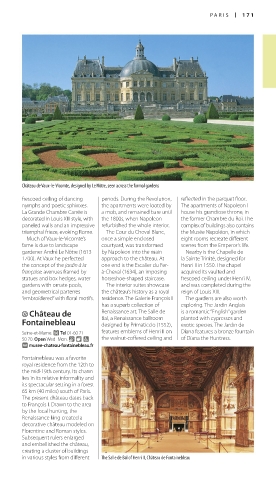
Château de Vaux-le-Vicomte, designed by Le Nôtre, seen across the formal gardens
frescoed ceiling of dancing periods. During the Revolution, reflected in the parquet floor.
nymphs and poetic sphinxes. the apartments were looted by The apartments of Napoleon I
La Grande Chambre Carrée is a mob, and remained bare until house his grandiose throne, in
decorated in Louis XIII style, with the 1800s, when Napoleon the former Chambre du Roi. The
paneled walls and an impressive refurbished the whole interior. complex of buildings also contains
triumphal frieze, evoking Rome. The Cour du Cheval Blanc, the Musée Napoléon, in which
Much of Vaux-le-Vicomte’s once a simple enclosed eight rooms recreate different
fame is due to landscape courtyard, was transformed scenes from the Emperor’s life.
gardener André Le Nôtre (1613– by Napoleon into the main Nearby is the Chapelle de
1700). At Vaux he perfected approach to the château. At la Sainte Trinité, designed for
the concept of the jardin à la one end is the Escalier du Fer- Henri II in 1550. The chapel
française: avenues framed by à-Cheval (1634), an imposing acquired its vaulted and
statues and box hedges, water horseshoe-shaped staircase. frescoed ceiling under Henri IV,
gardens with ornate pools, The interior suites showcase and was comp leted during the
and geometrical parterres the château’s history as a royal reign of Louis XIII.
“embroidered” with floral motifs. residence. The Galerie François I The gardens are also worth
has a superb collection of exploring. The Jardin Anglais
c Château de Renaissance art. The Salle de is a romantic “English” garden
Fontainebleau Bal, a Renaissance ballroom planted with cypresses and
designed by Primaticcio (1552),
exotic species. The Jardin de
Seine-et-Marne. £ Tel 01-60 71 features emblems of Henri II on Diana features a bronze fountain
50 70. Open Wed–Mon. & 8 7 the walnut-coffered ceiling and of Diana the Huntress.
∑ musee-chateau-fontainebleau.fr
Fontainebleau was a favorite
royal residence from the 12th to
the mid-19th century. Its charm
lies in its relative informality and
its spectacular setting in a forest
65 km (40 miles) south of Paris.
The present château dates back
to François I. Drawn to the area
by the local hunting, the
Renaissance king created a
decorative château modeled on
Florentine and Roman styles.
Subsequent rulers enlarged
and embellished the château,
creating a cluster of buildings
in various styles from different The Salle de Bal of Henri II, Château de Fontainebleau
170-171_EW_Europe.indd 171 14/07/16 10:14 am

