


Page 294 - (DK Eyewitness) Travel Guide - Europe
P. 294
292 THE IBERIAN PENINSULA
Northern Spain There is also the Centro Gallego
de Arte Contemporáneo, with
Northern Spain encompasses a variety of landscapes and works by leading Galician artists.
cultures. In the far northwest of the peninsula, the Galicians
are fiercely proud of their customs and language. Spain’s E Centro Gallego de Arte
greenest region, Galicia boasts some of the most attractive Contemporáneo
Calle Valle Inclán s/n. Tel 981-54 66 19.
stretches of Atlantic coast, as well as the beautiful city of Open Tue–Sun. 8 by prior
Santiago de Compostela. Popular with hikers and naturalists, appointment (call 981-54 66 23). 7
the spectacular Picos de Europa massif sits astride the border
between Asturias and Cantabria. The Basque Country is a 0 Rías Baixas
unique part of Spain, whose main attractions include superb
cuisine, fashionable seaside resorts, and the cultural center Pontevedra. £ @ Pontevedra. n
of Bilbao, with its famous Guggenheim Museum. Praza da Verdura s/n, Pontevedra (986-
09 08 90).
The southern part of Galicia’s west
coast consists of four large rías, or
inlets, between pine-covered hills.
Known as the Rías Baixas (Rías
Bajas), they offer fine beaches,
safe bathing, and lovely scenery.
The main town on the coast is
lively Pontevedra, which has
many historic monuments,
such as the Gothic Convento
de Santo Domingo, and an
excellent provincial museum.
Many areas along the coast
have become popular holiday
resorts, such as Sanxenxo, west
of Pontevedra. To the south,
Baiona and Panxón both have
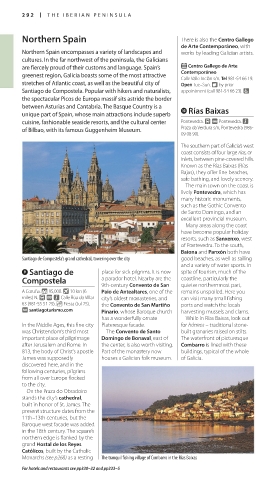
Santiago de Compostela’s grand cathedral, towering over the city good beaches, as well as sailing
and a variety of water sports. In
9 Santiago de place for sick pilgrims. It is now spite of tourism, much of the
Compostela a parador hotel. Nearby are the coastline, particularly the
9th-century Convento de San quieter northernmost part,
A Coruña. * 95,000. k 10 km (6 Paio de Antealtares, one of the remains unspoiled. Here you
miles) N. £ @ n Calle Rúa do Villar city’s oldest monasteries, and can visit many small fishing
63 (981-55 51 29). _ Fiesta (Jul 25). the Convento de San Martiño ports and watch the locals
∑ santiagoturismo.com Pinario, whose Baroque church harvesting mussels and clams.
has a wonderfully ornate While in Rías Baixas, look out
In the Middle Ages, this fine city Plateresque facade. for hórreos – traditional stone-
was Christendom’s third most The Convento de Santo built granaries raised on stilts.
important place of pilgrimage Domingo de Bonaval, east of The waterfront of picturesque
after Jerusalem and Rome. In the center, is also worth visiting. Combarro is lined with these
813, the body of Christ’s apostle Part of the monastery now buildings, typical of the whole
James was supposedly houses a Galician folk museum. of Galicia.
discovered here, and in the
following centuries, pilgrims
from all over Europe flocked
to the city.
On the Praza do Obradoiro
stands the city’s cathedral,
built in honor of St. James. The
present structure dates from the
11th–13th centuries, but the
Baroque west facade was added
in the 18th century. The square’s
northern edge is flanked by the
grand Hostal de los Reyes
Católicos, built by the Catholic
Monarchs (see p268) as a resting The tranquil fishing village of Combarro in the Rías Baixas
For hotels and restaurants see pp330–32 and pp333–5
292-293_EW_Europe.indd 292 14/07/16 10:15 am

