


Page 292 - (DK Eyewitness) Travel Guide - Europe
P. 292
290 THE IBERIAN PENINSULA
Burgos Cathedral
Spain’s third-largest cathedral was founded in 1221 under
Fernando III and was named a UNESCO World Heritage
site in 1984. The groundplan – a Latin cross – measures
84 m (276 ft) by 59 m (194 ft). Its construction was carried
out in several stages over three centuries, involving artists
and architects from across Europe. The style is almost
entirely Gothic, with influences from Germany, France,
and the Low Countries. In the Middle Ages, the cathedral
was a main stopping point for pilgrims on the road to
Santiago (see p292). Burgos’s most celebrated son, the
medieval hero of the Reconquest, El Cid, is buried in
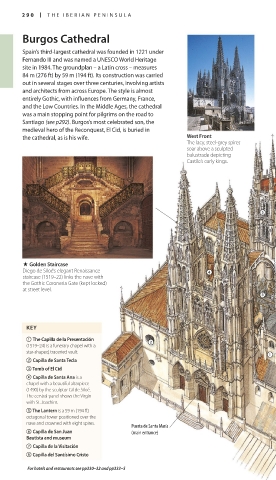
the cathedral, as is his wife. West Front
The lacy, steel-grey spires
soar above a sculpted
balustrade depicting
Castile’s early kings.
. Golden Staircase
Diego de Siloé’s elegant Renaissance
staircase (1519–22) links the nave with
the Gothic Coroneria Gate (kept locked)
at street level.
KEY
1 The Capilla de la Presentación
(1519–24) is a funerary chapel with a
star-shaped, traceried vault.
2 Capilla de Santa Tecla
3 Tomb of El Cid
4 Capilla de Santa Ana is a
chapel with a beautiful altarpiece
(1490) by the sculptor Gil de Siloé.
The central panel shows the Virgin
with St. Joachim.
5 The Lantern is a 59 m (194 ft)
octagonal tower positioned over the
nave and crowned with eight spires.
Puerta de Santa María
6 Capilla de San Juan (main entrance)
Bautista and museum
7 Capilla de la Visitación
8 Capilla del Santísimo Cristo
For hotels and restaurants see pp330–32 and pp333–5
290-291_EW_Europe.indd 290 14/07/16 10:15 am

