


Page 313 - (DK Eyewitness) Travel Guide - Europe
P. 313
SP AIN 311
k Costa del Sol
by Diego de Siloé. The
half-built second tower, k g £ @ Málaga. n Avda
abandoned in 1765, Cervantes 1, Málaga (95-220 96 03).
gave the cathedral its ∑ visitcostadelsol.com
nickname: La Manquita
(“the one-armed one”). With its year-round sunshine and
The Casa Natal varied coastline, the Costa del
de Picasso, where the Sol attracts crowds of vacationers
painter spent his early every year and also has half a
years, is now the million foreign residents.
headquarters of the Its most stylish resort is
international Picasso Marbella, frequented by royalty
Foundation, while the and film stars, who spend their
Museo Picasso Málaga summers here in the smart villas
is home to about 300 of or luxury hotels overlooking the
his works. area’s 28 beaches. Puerto Banús
The city’s vast is its ostentatious marina. In
fortress – the Alcazaba winter, the major attraction is
– was built between the golf: 30 of Europe’s finest golf
8th and 11th centuries. courses lie just inland.
The main facade of Málaga’s unusual cathedral, Its major attractions are Among the highlights of
consecrated in 1588 Phoenician, Roman, and Marbella’s old town is the Museo
Moorish artifacts, as well de Grabado Contemporáneo,
j Málaga as a Roman theater. The ruined which displays some of Picasso’s
Castillo de Gibralfaro, a least-known work, the peaceful
Málaga. * 570,000. k g £ @
n Avda. Cervantes 1 (95-220 96 03). 14th-century Moorish castle, Iglesia de Nuestra Señora de la
lies behind the Alcazaba. Encarnación, and the town hall,
Málaga, the second-largest city with its exquisite, panelled
in Andalusia, was a thriving port E Museo Picasso Málaga Mudéjar ceiling.
under Phoenician, Roman, and C/San Agustín 8. Tel 95-212 76 00. Sotogrande, to the west of
Moorish rule. It also flourished Open daily. Closed Dec 25, Jan 1 & 6. Marbella, is an exclusive resort.
during the 19th century, when & 8 7 ∑ museopicasso The marina is fronted by good
sweet Málaga wine was one of malaga.org seafood restaurants. In spite of
Europe’s most popular drinks. + Alcazaba tourism, Estepona preserves its
At the heart of the old town is Calle Alcazabilla. Tel 95-222 72 30. Spanish character, with pretty
the cathedral, begun in 1528 Open 9am–8pm daily. tree-filled squares and tapas bars.
To the east are the package-
Moorish Spain holiday resorts of Fuengirola
and Torremolinos. Once the
In the 8th century, the brash haunt of young northern
Iberian Peninsula came European tourists, they are now
almost entirely under more family-oriented.
Moorish rule. The Muslim
settlers called Spain “Al
Andalus.” A powerful
caliphate was established in
Córdoba, which became the
center of one of the most
brilliant civilizations of early-
medieval Europe. The Moors
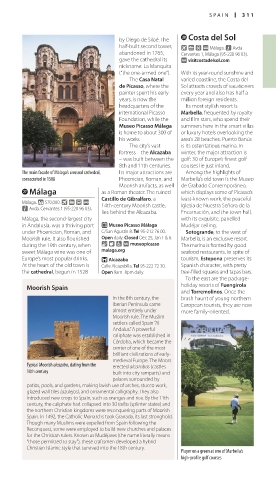
Typical Moorish alcazaba, dating from the erected alcazabas (castles
10th century built into city ramparts) and
palaces surrounded by
patios, pools, and gardens, making lavish use of arches, stucco work,
glazed wall tiles (azulejos), and ornamental calligraphy. They also
introduced new crops to Spain, such as oranges and rice. By the 11th
century, the caliphate had collapsed into 30 taifas (splinter states) and
the northern Christian kingdoms were reconquering parts of Moorish
Spain. In 1492, the Catholic Monarchs took Granada, its last stronghold.
Though many Muslims were expelled from Spain following the
Reconquest, some were employed to build new churches and palaces
for the Christian rulers. Known as Mudéjares (the name literally means
“those permitted to stay”), these craftsmen developed a hybrid
Christian-Islamic style that survived into the 18th century.
Player on a green at one of Marbella’s
high-profile golf courses
310-311_EW_Europe.indd 311 14/07/16 10:15 am

