


Page 478 - (DK Eyewitness) Travel Guide - Europe
P. 478
476 IT AL Y AND GREECE
f Crete
ATHENS
Rugged mountains, sparkling seas, and ancient history combine
with the Cretans’ relaxed nature to make this island an idyllic
vacation destination. The center of the Minoan civilization
over 3,000 years ago, Crete has also been occupied by
Romans, Byzantines, Venetians, and Turks. Historic towns such
as Irákleio, Chaniá, and Réthymno, and the famous Minoan
palaces at Knossos and Phaistos, give a fascinating insight Chaniá • Irákleio
•
into some of the most important periods in Cretan history. Réthymno • Crete
•
Phaistos
Locator Map
T Palace of Knossos
5 km (3 miles) S of Irákleio.
Tel 2810-231 940. @ Open daily.
Closed main public hols. & 8
The capital of Minoan Crete,
Knossos was the largest and
most sophisticated of the
Minoan palaces on the island.
Built around 1900 BC, the
first palace of Knossos was
destroyed by an earthquake in
about 1700 BC and was soon
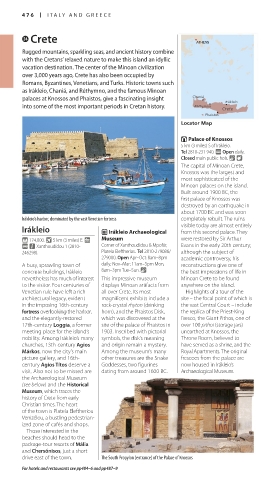
Irákleio’s harbor, dominated by the vast Venetian fortress completely rebuilt. The ruins
Irákleio E Irákleio Archaeological visible today are almost entirely
from this second palace. They
* 174,000. k 5 km (3 miles) E. g Museum were restored by Sir Arthur
@ n Xanthoudídou 1 (2810- Corner of Xanthoudídou & Mpofór, Evans in the early 20th century;
246298). Plateía Eleftherías. Tel 2810-279086/ although the subject of
279000. Open Apr–Oct: 8am–8pm academic controversy, his
A busy, sprawling town of daily; Nov–Mar: 11am–5pm Mon, reconstructions give one of
concrete buildings, Irákleio 8am–3pm Tue–Sun. & the best impressions of life in
nevertheless has much of interest This impressive museum Minoan Crete to be found
to the visitor. Four centuries of displays Minoan artifacts from anywhere on the island.
Venetian rule have left a rich all over Crete. Its most Highlights of a tour of the
architectural legacy, evident magnificent exhibits include a site – the focal point of which is
in the imposing 16th-century rock-crystal rhyton (drinking the vast Central Court – include
fortress overlooking the harbor, horn), and the Phaistos Disk, the replica of the Priest-King
and the elegantly-restored which was discovered at the Fresco, the Giant Pithos, one of
17th-century Loggia, a former site of the palace of Phaistos in over 100 pithoi (storage jars)
meeting place for the island’s 1903. Inscribed with pictorial unearthed at Knossos, the
nobility. Among Irákleio’s many symbols, the disk’s meaning Throne Room, believed to
churches, 13th-century Agios and origin remain a mystery. have served as a shrine, and the
Márkos, now the city’s main Among the museum’s many Royal Apartments. The original
picture gallery, and 16th- other treasures are the Snake frescoes from the palace are
century Agios Títos deserve a Goddesses, two figurines now housed in Irákleio’s
visit. Also not to be missed are dating from around 1600 BC. Archaeological Museum.
the Archaeological Museum
(see below) and the Historical
Museum, which traces the
history of Crete from early
Christian times. The heart
of the town is Plateía Eleftheríou
Venizélou, a bustling pedestrian-
ized zone of cafés and shops.
Those interested in the
beaches should head to the
package-tour resorts of Mália
and Chersónisos, just a short
drive east of the town. The South Propylon (entrance) of the Palace of Knossos
For hotels and restaurants see pp484–6 and pp487–9
476-477_EW_Europe.indd 476 14/07/16 10:10 am

