


Page 479 - (DK Eyewitness) Travel Guide - Europe
P. 479
THE GREEK ISLANDS 477
Phaistos The Mosque of the Janissaries,
65 km (40 miles) SW of Irákleio. on one side of the harbor, dates
Tel 28920-42315. @ Open 8am– back to the arrival of the Turks in
8pm daily (winter: 8am–6pm). 1645, and is the oldest Ottoman
Closed main public hols. & building on Crete. The lively
covered market is an area worth
Phaistos was one of the most exploring. Nearby the
important Minoan palaces Archaeological Museum is
on Crete. In 1900 Italian-led housed in the Venetian church
excavations unearthed two of San Francesco.
palaces. Remains of the first Some 4 km (2 miles) west of
palace, constructed around Chaniá, the relatively undisturbed
1900 BC and destroyed by an beach of Agioi Apóstoloi
earthquake in 1700 BC, are still comprises two attractive coves.
visible. Most of the present
ruins, however, are of the
second palace. Phaistos was Samariá Gorge The narrow defile known as the Iron Gates
finally destroyed in the 2nd 44 km (27 miles) S of Chaniá. @ to in the Samariá Gorge
century BC by the ancient Xylóskalo. g Agía Rouméli to Sfakía Réthymno
city-state of Górtys. or Palaiochóra (via Soúgia); check time
The most impressive remains of last boat back at the outset. Open * 32,000. @ n Sofokli Venizélou
are the Grand Staircase, which May–mid-Oct: 6am–4pm daily; Apr (28310-29148).
was the main entrance to the 10–30 & Oct 16–31: if weather permits.
palace, and the Central Court. Despite tourism and modern
A few kilometers northeast Crete’s most spectacular development, Réthymno has
of Phaistos, the archaeological scenery lies along the Samariá retained much of its charm.
remains of ancient Górtys date Gorge, the longest ravine in The old quarter is rich in well-
from about 1000 BC to the late Europe. When it became a preserved Venetian and
7th century AD. national park, the inhabitants of Ottoman architecture, including
the village of Samariá moved the elegant 16th-century
Agios Nikólaos elsewhere, leaving behind the Venetian Lótzia (Loggia) and
ruined buildings and chapels
the Nerantzés Mosque, a
* 11,400. g @ n Koundoúrou 21 seen here today. Starting from converted Franciscan church
(28410-22357). ( Wed. the Xylóskalo (Wooden Stairs), that is now a concert hall. The
an 18-km- (11-mile-) trail leads huge Fortétsa was built by the
The main transport hub for the to the seaside village of Agía Venetians in the 16th century
east of the island, delightful Rouméli. A truly impressive to defend the port against both
Agios Nikólaos is a thriving sight along the route is the pirates and the Turks. Below it is
vacation center with an Sideróportes, or Iron Gates, a pretty harbor, lined with cafés
attractive port and fine beaches where the path squeezes and restaurants. Also worth
some distance east, as well as between two towering walls visiting are the Archaeological
an interesting Folk Museum and of rock, only 3 m (9 ft) apart. Museum and the Historical and
an Archaeological Museum. Upon reaching Agía Rouméli, Folk Art Museum.
A few kilometers north is walkers can take a boat to East of Réthymno, there are
the well-established resort of Sfakía, Soúgia, or Palaiochóra several resorts, while to the
Eloúnda, boasting a good range to join the road and buses west lies a 20 km (12 mile)
of accommodations plus boat back to Chaniá. stretch of uncrowded beach.
trips to Spinalónga islet.
Chaniá
* 54,000. k 16 km (10 miles) E.
g @ n Kriári 40 (28210-92943).
One of Crete’s most appealing
cities, Chaniá was ruled by the
Venetians from 1204 to 1645,
and is dotted with elegant
houses, churches, and
fortifications dating from this
period. Many of these can be
found in the Venetian quarter
around the harbor, and in the
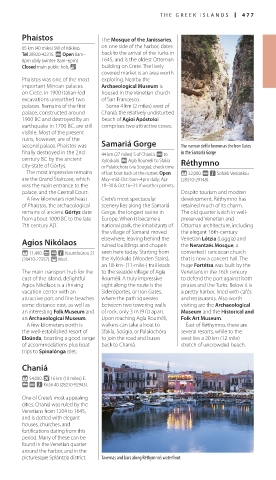
picturesque Splántzia district. Tavernas and bars along Réthymno’s waterfront
476-477_EW_Europe.indd 477 14/07/16 10:10 am

