


Page 130 - How It Works - Book of Amazing Answers To Curious Questions, 12
P. 130
� AMAZIG ANSWERS TO CURIOUS QUESTIONS -------------------
Google's software uses a little artificial
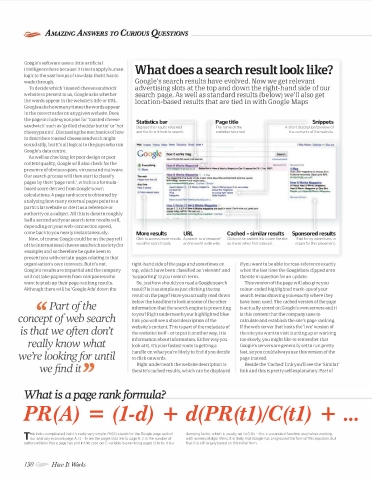
intelligence here because it tries to apply human What does a search result lool< lil<e?
logic to the vast lumps of raw data thatit has to
wade through. Google's search results have evolved. Now we get relevant
To decide which 'toasted cheese sandwich' advertising slots at the top and down the right-hand side of our
website to present to us, Google asks whether search page. As well as standard results (below) we'll also get
the words appear in the website's title or URL. location-based results that are tied in with Google Maps
Google asks how many times the words appear
in the correct order on any given website. Does
the page include synonyms for 'toasted cheese Statistics bar Page title Snippets
sandwich' such as 'grilled cheddar buttie' or 'hot Displays the results returned The name of the A short description/preview of
cheesy panini'. Discussing the mechanics of how and the time it took to search. websites returned. the contents of the website.
to describe a toasted cheese sandwich might
sound silly, but it's all logical to the guys who run -
Google's data centre.
As well as checking for poor design or poor Go gle
content quality, Google will also check for the
'J �nt ul"'
presence of obvious spam, viruses and malware. . .... �-. ...... � ,..........a.u-..b't•, ,._"'" 0Mrt2QO ........... tr)G'100Mft011'1
Our search process will then start to classify HowhWofbYtga .__,. ... .... ,._«<CCIJ" SW. Iap ID emL
....... ....n
nt.,....._,_.,_.,_. L_ .._._..,.�IC*! IOIIOt
pages by their 'page rank', which is a formula � ........... t!IIIICft ,... How n WotM Mtauot
_,__,_ ..._
o\OC ...... llWI6rM ..... M
based score derived from Google's own ... w.b tl ••• · �� ..... ._.. ...... _..., ._,w.n;,��OM8011111
OllnlaIJI
ADo.tw �
jlrOt�
......
calculations. A page rank score is obtained by ... ......._... ..........
--
-
analysing how many external pages point to a
particular website or cite it as a reference or
authority on a subject. All this is done in roughly
half a second and your search term results will,
depending on your web-connection speed,
come back to you nearly instantaneously. More results URL Cached - similar results Sponsored results
Now, of course Google could be on the payroll Click to access more results A pointer to a 'resource' Click on the cached link to see the site Paid for by advertisers in
via other search tools. on the world wide web. as it was when first indexed. return for this placement.
of the international cheese sandwich society (for
example) and so therefore be quite keen to
present you with certain pages relating to that
organisation's own interests. But it's not. right-hand side of the page and sometimes on if you want to be able to cross-reference exactly
Google's results are impartial and the company top, which have been classified as 'relevant' and when the last time the Googlebots dipped onto
will not take payments from companies who 'supporting' to your search term. the site in question for an update.
want to push up their page-ranking results. So, just how should you read a Google search This version of the page will also give you
Although there will be 'Google Ads' down the result? Is it as simple as just clicking the top colour-coded highlighted mark-ups of your
result on the page? Have you actually read down search terms showing you exactly where they
'' Part of the below the headline to look at some of the other have been used. The cached version of the page
is actually stored on Google's own servers and it
information that the search engine is presenting
concept of web search to you? Right underneath your highlighted blue is this content that the company uses to
calculate and establish the site's page ranking.
link you will see a short description of the
is that we often don't website's content. This is part of the metadata of If the web server that hosts the 'live' version of
the website itself- or to put it another way, itis
the site you want to visit is acting up or working
really know what information about information. Either way you too slowly, you might like to remember that
Google's servers are generally set to run pretty
look at it, it's your fastest route to getting a
we're looking for until handle on what you're likely to find if you decide fast, so you could always use this version of the
to click onwards.
page instead.
Right underneath the website description is
Beside the 'Cached' link you'll see the 'Similar'
we find it'' the site's cached results, which can be displayed link and this is pretty self explanatory. Part of
M&at �pa �JD� ����-------------------------
PR(A) = (1-d) + d(PR(tl)!C(tl) + •••
his looks complicated, but it's really very simple: PR(A) stands for the Google page rank of damping factor, which is usually set to 0.85 - this is a standard function used when working
Tour arbitrary example page A. tl - tn are the pages that link to page A. Cis the number of with numerical algorithms. It is likely that Google has progressed the form of this equation, but
outbound links that a page has and in this case our C variable is examining pages t1 to tn. dis a that it is still largely based on this initial form.
130 How It f.#Jrks WorldMags.net
WorldMags.net

