


Page 75 - How It Works - Book of Amazing Answers To Curious Questions, 12
P. 75
---- Environment                                                                                     Q�
                              _______________


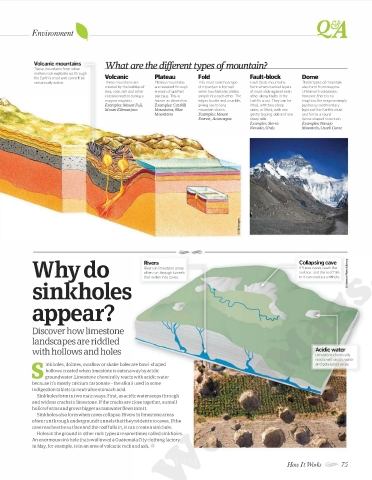
            Volcanic mountains     What are the differe type of mountain?
            These mountains form when
            molten rock explodes up through
            the Earth's crust and can still be   Volcanic   Plateau   Fold       Fault-block      Dome
            volcanically active.   These mountains are   Plateau mountains   This most common type   Fault-block mountains   These types of mountain
                                   created by the buildup of   are revealed through   of mountain is formed   form when cracked layers   also form from magma.
                                   lava, rock, ash and other   erosion of uplifted   when two tectonic plates   of crust slide against each   Unlike with volcanoes,
                                   volcanic matter during a   plateaus. This  is   smash into each other. The   other along faults in the   however, there is no
                                   magma eruption.   known as dissection.   edges buckle and crumble,   Earth's crust. They can be   eruption; the magma simply
                                   Examples: Mount Fuji,   Examples: Catskill   giving rise to  long   lifted, with two steep   pushes up sedimentary
                                   Mount Kilimanjaro   Mountains, Blue   mountain chains.   sides; or lifted, with one   layers of the Earth's crust
                                                  Mountains     Examples: Mount   gently sloping side and one   and forms a round
                                                                Everest, Aconcagua   steep side.   dome-shaped mountain.
                                                                                 Examples: Sierra   Examples: Navajo
                                                                                 Nevada, Urals    Mountain, Ozark Dome


            --------------------------------------------- �� ---------------------------------------------
           Why do                              often  run through tunnels                        Collapsing cave
                                               Rivers
                                                                                                 If these caves reach the
                                               Rivers in limestone areas
                                                                                                 surface  and the roof falls
                                                                                                 in it can create a sinkhole.
                                               that widen into caves.
           sinl<holes
           appear?


           Discover how limestone
           landscapes are riddled
           with hollows and holes

                inkholes, do lines, swallow or shake holes are bowl-shaped
                hollows created when limestone is eaten away by acidic
           S  groundwater. Limestone chemically reacts with acidic water
           because it's mostly calcium carbonate -the alkali used in some
           indigestion tablets to neutralise stomach acid.
             Sinkholes form in two main ways. First, as acidic water seeps through
           and widens cracks in limestone. If the cracks are close together, a small
           hollow forms and grows bigger as rainwater flows into it.
             Sinkholes also form when caves collapse. Rivers in limestone areas
           often run through underground tunnels that they widen into caves. If the
           cave reaches the surface and the roof falls in, it can create a sinkhole.
             Holes in the ground in other rock types are sometimes called sinkholes.
           An enormous sinkhole that swallowed a Guatemala City clothing factory
           in May, for example, is in an area of volcanic rock and ash.


                                                WorldMags.net                                How It T%rks     75
                                                WorldMags.net

