


Page 74 - How It Works - Book of Amazing Answers To Curious Questions, 12
P. 74
AMAZIG ANSWERS TO CURIOUS QUESTIONS -------------------


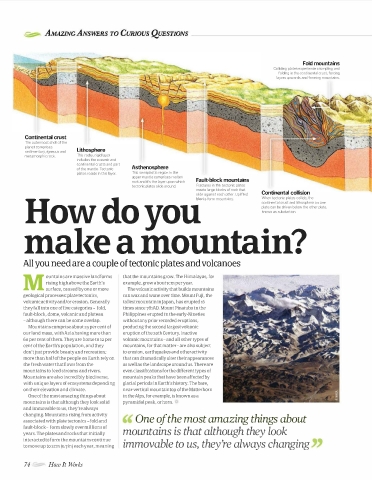
                                                                                                  Fold mountains
                                                                                         Colliding plates experience crumpling and
                                                                                          folding in the continental crust, forcing
                                                                                          layers upwards and forming mountains.


         Continental crust
         The outermost shell of the
         planet comprises
         sedimentary, igneous and   Lithosphere
         metamorphic rock.   This  rocky, rigid layer
                          includes the oceanic and
                          continental crusts and part
                          of the mantle. Tectonic   Asthenosphere
                          plates reside in this layer.   This semiplastic region in the
                                           upper mantle comprises molten
                                           rock and it's the layer upon which   Fault-block mountains
                                           tectonic plates slide around.   Fractures in the tectonic plates
                                                                create large blocks of rock that   Continental collision
                                                                slide against each other. Uplifted
                                                                                     When tectonic plates collide, the
                                                                  '' ' mm moom  ..  ,
         H       OV\T dO                       y     o     U                         continental crust and lithosphere on one
                                                                                     plate can be driven below the other plate,
                                                                                     known as subduction.
         mal<e a mountain?


        All you need are a couple of tectonic plates and volcanoes

                ountains are massive landforms   that the mountains grow. The Himalayas, for
                rising high above the Earth's   example, grow about1cm per year.
        M  surface, caused by one or more   The volcanic activity that builds mountains
        geological processes: plate tectonics,   can wax and wane over time. Mount Fuji, the
        volcanic activity and/or erosion. Generally   tallest mountain in japan, has erupted 16
        they fall into one of five categories - fold,   times since 781AD. Mount Pinatubo in the
        fault-block, dome, volcanic and plateau   Philippines erupted in the early-Nineties
        -although there can be some overlap.   without any prior recorded eruptions,
          Mountains comprise about 25 per cent of   producing the second largest volcanic
        our land mass, with Asia having more than   eruption of the 2oth Century. Inactive
        6o per cent of them. They are home to 12 per   volcanic mountains- and all other types of
         cent of the Earth's population, and they   mountains, for that matter-are also subject
         don't just provide beauty and recreation;   to erosion, earthquakes and other activity
        more than half of the people on Earth rely on   that can dramatically alter their appearances
         the fresh water that flows from the   as well as the landscape around us. There are
        mountains to feed streams and rivers.   even classifications for the different types of
         Mountains are also incredibly biodiverse,   mountain peaks that have been affected by
        with unique layers of ecosystems depending   glacial periods in Earth's history. The bare,
         on their elevation and climate.   near-vertical mountaintop of the Matterhorn
          One of the most amazing things about   in the Alps, for example, is known as a
        mountains is that although they look solid   pyramidal peak, or horn.
        and immovable to us, they're always
         changing. Mountains rising from activity
        associated with plate tectonics -fold and   One of the most amazing things about
         fault-block- form slowly over millions of
        years. The plates and rocks that initially   mountains is that although they look
        interacted to form the mountains continue
        to move up to 2cm (0.7in) each year, meaning  immovable to us, they're always changing

         74     Howlt TtOrks                    WorldMags.net
                                                WorldMags.net

