


Page 70 - How It Works - Book of Amazing Answers To Curious Questions, 12
P. 70
AMAZIG ANSWERS TO CURIOUS QUESTIONS -------------------
When drainage systems are
overwhelmed by rainwater, the result
can often be a torrent of water up to
six metres high
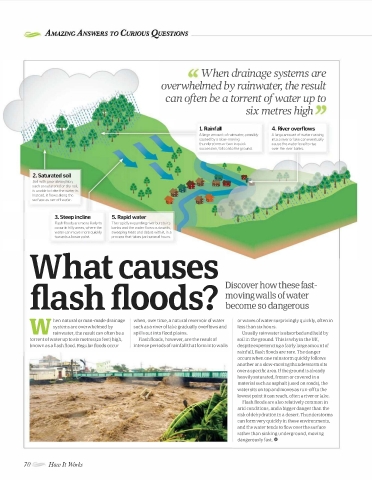
1. Rainfall 4. River overflows
A large amount of rainwater, possibly A large amount of water running
caused by a slow-moving into a river or lake can eventually
thunderstorm or two in quick cause the water level to rise
succession, falls onto the ground. over the river banks.
2. Saturated soil
Soil with poor absorption,
such as saturated or dry soil,
is unable to take the water in.
Instead, it flows along the
surface as run-off water.
3. Steep incline
Flash floods are more likely to The rapidly expanding river bursts its
occur in hilly areas, where the banks and the water flows outwards,
water can move more quickly sweeping trees and debris with it, in a
towards a lower point. process that takes just several hours.
What causes
Discover how these fast
moving walls of water
flash floods? become so dangerous
hen natural or man-made drainage when, over time, a natural reservoir of water or waves of water surprisingly quickly, often in
systems are overwhelmed by such as a river oflake gradually overflows and less than six hours.
W rainwater, the result can often be a spills out into flood plains. Usually rainwater is absorbed and held by
torrent of water up to six metres 120 feet) high, Flash floods, however, are the result of soil in the ground. This is why in the UK.
known as a flash flood. Regular noods occur intense periods of rainfall that form into walls despite experiencing a fairly large amount of
rainfall, nash noods are rare. The danger
occurs when one rainstorm quickly follows
another or a slow-moving thunderstorm sits
over a specific area. If the ground is already
heavily saturated, frozen or covered in a
material such as asphalt (used on roads), the
water sits on top and moves as run-off to the
lowest point it can reach, often a river or lake.
Flash noods are also relatively common in
arid conditions, and a bigger danger than the
risk of dehydration in a desert. Thunderstorms
can form very quickly in these environments,
and the water tends to now over the surface
rather than sinking underground, moving
dangerously fast. 0
70 How It TtOrks WorldMags.net
WorldMags.net

