


Page 121 - (DK Eyewitness) Travel Guide - Brittany
P. 121
BRIT T AN Y REGION B Y REGION 119
NORTHERN
FINISTÈRE
Two very distinct geographical and historical entities make up
northern Finistère. West of the Morlaix river lies the territory of the
former diocese of the Léon, whose religious and economical capital
was St-Pol. East of Morlaix is a small section of the Trégor, the
neighbouring diocese that became part of Finistère after the Revolution.
The Trégor Finistérien, that part of the inhabitants who, from the 13th century,
Trégor annexed to Finistère, is a charming had grown rich through the thriving
part of Brittany, a patchwork of valleys linen cloth trade.
and sunken lanes. The Léon, by contrast, The Bas-Léon, surrounded on three
is a large plateau that in the 1960s was sides by the sea (the Abers, the Mer
stripped of its trees to maximize intensive d’Iroise and the Rade de Brest), has
agriculture. This is especially true quite a different landscape. Here are
of the Haut-Léon, a prime producer of wide deserted beaches and narrow
artichokes and cauliflowers. Its commercial secret creeks, wooded estuaries and
dynamism even led to the creation of cliffs topped by light houses, banks of
Brittany Ferries, founded to export the dunes and wind swept promontories.
Léon’s prized local produce. In the extreme west, battered by the
Commercially successful, the Haut- Atlantic Ocean, lies Ouessant, the end
Léon is also deeply religious. Not for of the known world in ancient times,
nothing is it known as “the land of priests”, and the low-lying islands of the Molène
and it boasts some of Brittany’s archipelago, which, like the Monts d’Arrée
architectural jewels: the parish closes, and the magical forest of Huelgoat, form
built with funds provi ded by local rural part of the Parc Régional d’Armorique.
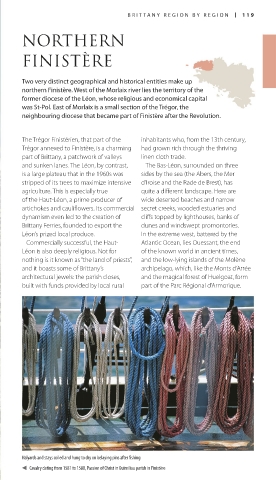
Halyards and stays coiled and hung to dry on belaying pins after fishing
Cavalry dating from 1581 to 1588, Passion of Christ in Guimiliau parish in Finistère
118-119_EW_Brittany.indd 119 11/3/16 1:02 PM

