


Page 124 - (DK Eyewitness) Travel Guide - Brittany
P. 124
122 BRIT T AN Y REGION B Y REGION
1 Street-by-Street: Morlaix
On the border of the Léon to the west and the
Trégor to the east, and with the sea to the north
and the Monts d’Arrée to the south, Morlaix
(Montroulez in Breton) was once one of the
largest ports on the English Channel. From early
times, ship owners, privateers and merchants
exploited to the full the town’s favourable
geographical location. Its focal point were the
docks, from which ships bound for Spain were
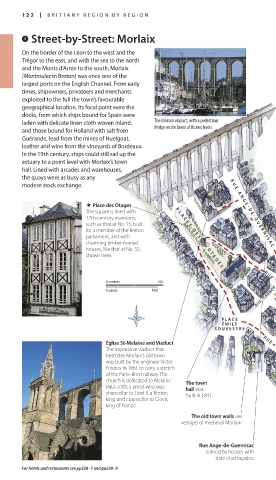
laden with delicate linen cloth woven inland, The Morlaix viaduct, with a pedestrian
bridge on the lower of its two levels
and those bound for Holland with salt from
Guérande, lead from the mines of Huelgoat,
leather and wine from the vine yards of Bordeaux.
In the 19th century, ships could still sail up the
estuary to a point level with Morlaix’s town
hall. Lined with arcades and warehouses,
the quays were as busy as any
modern stock exchange.
. Place des Otages
The square is lined with R U E A N G E - D E - G U E R N I S A C
17th-century mansions,
such as that at No. 15, built
for a member of the Breton
parliament, and with P L A C E S D E S O T A G E S
charming timber-framed
houses, like that at No. 32,
shown here.
PL A CE
R U E
0 metres 100 D E VIARNES
RU E C A R N OT
0 yards 100
PL A CE
É MILE G R A N D ’ R U E
SOUVESTRE
Église St-Melaine and Viaduct R U E
The impressive viaduct that
bestrides Morlaix’s old town
was built by the engineer Victor
Fenoux in 1861 to carry a stretch
of the Paris–Brest railway. The
church is dedicated to Melaine The town
(462–530), a priest who was hall was
chancellor to Hoel II, a Breton built in 1841.
king, and counsellor to Clovis,
king of France.
The old town walls are
vestiges of medieval Morlaix.
Rue Ange-de-Guernisac
is lined by houses with
slate-clad façades.
For hotels and restaurants see pp226–7 and pp238–9
122-123_EW_Brittany.indd 122 11/3/16 12:42 PM

