


Page 142 - (DK Eyewitness) Travel Guide - Brittany
P. 142
140 BRIT T AN Y REGION B Y REGION
P Cours Dajot built by Vauban in 1683,
This promenade on the contains the oldest exhibits,
southern part of the town which include ship models,
walls was built by convicts lanterns, pieces salvaged from
in 1769, to a plan by Dajot, wrecks and wooden figure
a pupil of Vauban. It offers heads carved in the work shops
a panoramic view of the of the naval dockyard. The
commercial port, built in modern collections, with
1860, and of Brest’s famous navigational instruments, a
roadstead, which has long German minisubmarine, and
given it a strategic and military other exhibits, are displayed
advantage. Like a huge marine in the gatehouse towers.
amphitheatre, the roadstead From the top of the keep
covers 150 sq km (60 sq miles) there is a fine view of the
between the Elorn estuary and Quartier de Recouvrance
the Pointe des Espagnols, with and the Penfeld river.
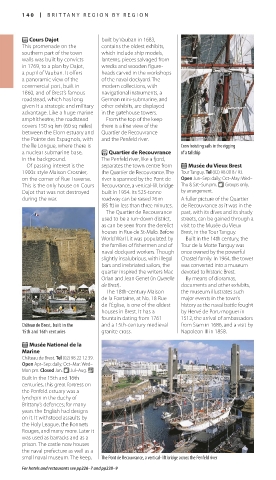
the Île Longue, where there is Crew hoisting sails in the rigging
a nuclear submarine base, P Quartier de Recouvrance of a tallship
in the background. The Penfeld river, like a fjord,
Of passing interest is the separates the town centre from E Musée du Vieux Brest
1900sstyle Maison Crosnier, the Quartier de Recouvrance. The Tour Tanguy. Tel (02) 98 00 87 93.
on the corner of Rue Traverse. river is spanned by the Pont de Open Jun–Sep: daily; Oct–May: Wed–
This is the only house on Cours Recouvrance, a verticallift bridge Thu & Sat–Sun pm. 8 Groups only,
Dajot that was not destroyed built in 1954. Its 525tonne by arrangement.
during the war. roadway can be raised 26 m A fuller picture of the Quartier
(85 ft) in less than three minutes. de Recouvrance as it was in the
The Quartier de Recouvrance past, with its dives and its shady
used to be a rundown district, streets, can be gained through a
as can be seen from the derelict visit to the Musée du Vieux
houses in Rue de StMalo. Before Brest, in the Tour Tanguy.
World War II, it was populated by Built in the 14th century, the
the families of fishermen and of Tour de la MotteTanguy was
naval dock yard workers. Though once owned by the powerful
slightly insalubrious, with illegal Chastel family. In 1964, the tower
bars and inebriated sailors, the was converted into a museum
quarter inspired the writers Mac devoted to historic Brest.
Orlan and Jean Genet (in Querelle By means of dioramas,
de Brest). documents and other exhibits,
The 18thcentury Maison the museum illustrates such
de la Fontaine, at No. 18 Rue major events in the town’s
de l’Église, is one of the oldest history as the naval battle fought
houses in Brest. It has a by Hervé de Portzmoguer in
fountain dating from 1761 1512, the arrival of ambassadors
Château de Brest, built in the and a 15thcentury medieval from Siam in 1686, and a visit by
15th and 16th centuries granite cross. Napoleon III in 1858.
E Musée National de la
Marine
Château de Brest. Tel (02) 98 22 12 39.
Open Apr–Sep: daily; Oct–Mar: Wed–
Mon pm. Closed Jan. 8 Jul–Aug. &
Built in the 15th and 16th
centuries, this great fortress on
the Penfeld estuary was a
lynchpin in the duchy of
Brittany’s defences; for many
years the English had designs
on it. It withstood assaults by
the Holy League, the Bonnets
Rouges, and many more. Later it
was used as barracks and as a
prison. The castle now houses
the naval prefecture as well as a
small naval museum. The keep, The Pont de Recouvrance, a vertical-lift bridge across the Penfeld river
For hotels and restaurants see pp226–7 and pp238–9
140-141_EW_Brittany.indd 140 11/3/16 1:03 PM

