


Page 140 - (DK Eyewitness) Travel Guide - Brittany
P. 140
138 BRIT T AN Y REGION B Y REGION
y Brest R Église St-Louis
Place St-Louis, Rue de Lyon.
The second-largest town in Brittany after Rennes, Brest has Open daily. 7
always played a leading military role. From the early days of Built between 1953 and 1958 on
the Roman Empire, legionnaires had seen the advantage of the site of the original church of
establishing a secure base on the rocky spur here, overlooking St-Louis, which was destroyed in
1944, this place of worship is the
a river, the Penfeld, and perfectly protected by a peninsula, largest of all those built in France
the Presqu’île de Crozon. At the instigation of Richelieu, in the post-war period.
Colbert and Vauban, who throughout the 17th century The materials used – yellow
worked to transform this natural harbour into the kingdom’s stone from Logonna-Daoulas
foremost naval base, life in the city revolved around the naval and reinforced concrete – are a
clear departure from Breton
dockyard. Brest remained a major shipyard until World War II. architectural traditions, and they
After 165 bombing raids and 43 days of siege, the conflict produce an admirable effect.
reduced Brest to rubble. The bold lines and restrained
decoration of the interior are no
less impressive.
The church has two notable
features: stained-glass windows
on the west front, by Paul Bony,
and a lectern in the shape of
an eagle, one of the very few
pieces that were salvaged from
the original church.
P Quartier St-Martin
The former outlying district
of St-Martin, which became
part of Brest in 1861, is one
of the few surviving quarters
of the old town. It is also one
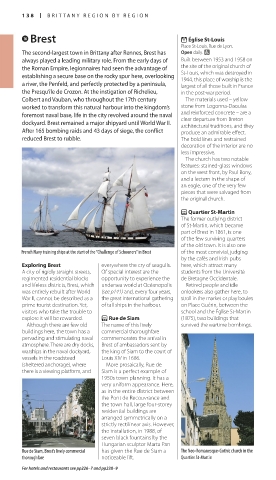
French Navy training ships at the start of the “Challenge of Schooners” in Brest of the most convivial, judging
by the cafés and Irish pubs
Exploring Brest everywhere the cry of seagulls. here, which attract many
A city of rigidly straight streets, Of special interest are the students from the Université
regimented residential blocks opportunity to experience the de Bretagne Occidentale.
and lifeless districts, Brest, which undersea world at Océanopolis Retired people and idle
was entirely rebuilt after World (see p141) and, every four years, onlookers also gather here, to
War II, cannot be described as a the great international gathering stroll in the market or play boules
prime tourist destination. Yet, of tall ships in the harbour. on Place Guérin, between the
visitors who take the trouble to school and the Église St-Martin
explore it will be rewarded. P Rue de Siam (1875), two buildings that
Although there are few old The name of this lively survived the wartime bombings.
buildings here, the town has a commercial thoroughfare
pervading and stimulating naval commemorates the arrival in
atmosphere. There are dry docks, Brest of ambassadors sent by
warships in the naval dockyard, the king of Siam to the court of
vessels in the roadstead Louis XIV in 1686.
(sheltered anchorage), where More prosaically, Rue de
there is a viewing platform, and Siam is a perfect example of
1950s town planning. It has a
very uniform appearance. Here,
as in the entire district between
the Pont de Recouvrance and
the town hall, large four-storey
residential buildings are
arranged symmetrically on a
strictly rectilinear axis. However,
the installation, in 1988, of
seven black fountains by the
Hungarian sculptor Marta Pan
Rue de Siam, Brest’s lively commercial has given the Rue de Siam a The Neo-Romanesque-Gothic church in the
thoroughfare noticeable lift. Quartier St-Martin
For hotels and restaurants see pp226–7 and pp238–9
138-139_EW_Brittany.indd 138 11/3/16 1:03 PM
Eyewitness Travel LAYERS PRINTED:
Catalogue template “UK” LAYER
(Source v2.9)
Date 28th May 2014
Size 125mm x 217mm

