


Page 154 - (DK Eyewitness) Travel Guide - Brittany
P. 154
152 BRIT T AN Y REGION B Y REGION
altarpiece of the Ten Thousand
Martyrs (see pp154–5), also
dating from the 16th century.
3 Pointe des
Espagnols
This promontory on the north
side of the Presqu’île de Crozon
encloses Brest’s roadstead (see
p140) and also offers a view of
Île Longue, where there is a
nuclear submarine base.
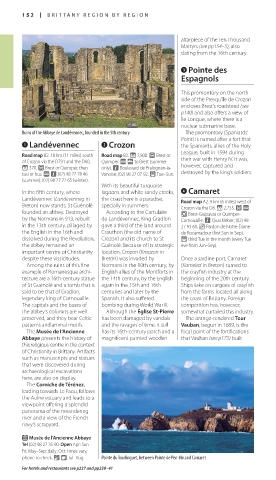
Ruins of the Abbaye de Landévennec, founded in the 5th century The promontory (Spaniards’
Point) is named after a fort that
1 Landévennec 2 Crozon the Spaniards, allies of the Holy
League, built in 1594 during
Road map B2. 18 km (11 miles) south Road map B2. * 7,800. £ Brest or
of Crozon via the D791 and the D60. Quimper. @ g to Brest (summer their war with Henry IV. It was,
* 370. £ Brest or Quimper, then only). n Boulevard de Pralognan-la- however, captured and
taxi or bus. @ n (02) 98 27 78 46 Vanoise; (02) 98 27 07 92. ( Tue–Sun. destroyed by the king’s soldiers.
(summer); (02) 98 27 72 65 (winter).
With its beautiful turquoise
In the fifth century, where lagoons and white sandy creeks, 4 Camaret
Landévennec (Landevenneg in the coast here is a paradise, Road map A2. 9 km (6 miles) west of
Breton) now stands, St Guénolé specially in summers. Crozon via the D8. * 2,735. £ @
founded an abbey. Destroyed According to the Cartulaire k Brest-Guipavas or Quimper-
by the Normans in 913, rebuilt de Landévennec, King Gradlon Cornouaille. n Quai Kléber; (02) 98
in the 13th cen tury, pillaged by gave a third of the land around 27 93 60. _ Pardon de Notre-Dame
the English in the 16th and Crauthon (the old name of de Rocamadour (first Sun in Sep).
dissolved during the Revolution, Crozon) and its church to St ( third Tue in the month (every Tue
the abbey remained an Guénolé. Because of its strategic eve from Jun–Sep).
important centre of Christianity location, Crozon (Kraozon in
despite these vissicitudes. Breton) was invaded by Once a sardine port, Camaret
Among the ruins of this fine Normans in the 10th century, by (Kameled in Breton) turned to
example of Romanesque archi- English allies of the Montforts in the crayfish industry at the
tecture are a 16th-century statue the 14th century, by the English beginning of the 20th century.
of St Guénolé and a tomb that is again in the 15th and 16th Ships take on cargoes of crayfish
said to be that of Gradlon, centuries and later by the from the farms located all along
legendary king of Cornouaille. Spanish. It also suffered the coast of Brittany. Foreign
The capitals and the bases of bombing during World War II. competition has, however,
the abbey’s columns are well Although the Église St-Pierre somewhat curtailed this industry.
preserved, and they bear Celtic has been damaged by vandals The orange-rendered Tour
patterns and animal motifs. and the ravages of time, it still Vauban, begun in 1689, is the
The Musée de l’Ancienne has its 16th-century porch and a focal point of the fortifications
Abbaye presents the history of magnificent painted wooden that Vauban (see p173) built
this religious centre in the context
of Christianity in Brittany. Artifacts
such as manuscripts and statues
that were discovered during
archaeological excavations
here, are also on display.
The Corniche de Térénez,
leading towards Le Faou, follows
the Aulne estuary and leads to a
viewpoint offering a splendid
panorama of the meandering
river and a view of the French
navy’s scrapyard.
E Musée de l’Ancienne Abbaye
Tel (02) 98 27 35 90. Open Apr: Sun–
Fri; May–Sep: daily; Oct: times vary,
phone to check. & 8 Jul–Aug. Pointe du Tourlinguet, between Pointe de Pen-Hir and Camaret
For hotels and restaurants see p227 and pp239–41
152-153_EW_Brittany.indd 152 11/3/16 1:03 PM

