


Page 159 - (DK Eyewitness) Travel Guide - Brittany
P. 159
SOUTHERN FINISTÈRE 157
The Pleyben Calvary
This gospel in stone, designed for the edification of illiterate worshippers, was
constructed in 1555 and completed in 1650 with the addition of sculptures by Julien
Ozanne, of Brest. These, carved in kersanton, the dark Breton granite, are on the first tier
of the east side of the calvary. They depict The Last Supper, The Entry into Jerusalem, and
Christ Washing the Feet of his Disciples. In 1738, the calvary was given the monumental
appearance that it has today. There are two curious depictions. One, on the northeastern
spur, shows the Devil disguised as a monk who tempts Christ. The other, on the western
side, is of Peter weeping for his denial of Christ before a cockerel, of which only the feet
survive. The scenes are arranged in sequence, starting with The Visitation, in which the
angel appears to Mary. The next scene is The Nativity.
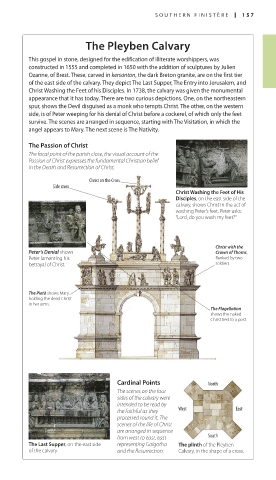
The Passion of Christ
The focal point of the parish close, the visual account of the
Passion of Christ expresses the fundamental Christian belief
in the Death and Resurrection of Christ.
Christ on the Cross
Side cross
Christ Washing the Feet of His
Disciples, on the east side of the
calvary, shows Christ in the act of
washing Peter’s feet. Peter asks:
“Lord, do you wash my feet?”
Christ with the
Peter’s Denial shows Crown of Thorns,
Peter lamenting his flanked by two
betrayal of Christ. soldiers.
The Pietà shows Mary
holding the dead Christ
in her arms.
The Flagellation
shows the naked
Christ tied to a post.
Cardinal Points North
The scenes on the four
sides of the calvary were
intended to be read by
the faithful as they West East
processed round it. The
scenes of the life of Christ
are arranged in sequence
from west to east, east South
The Last Supper, on the east side representing Golgotha The plinth of the Pleyben
of the calvary. and the Resurrection. Calvary, in the shape of a cross.
156-157_EW_Brittany.indd 157 11/3/16 1:03 PM

