


Page 168 - (DK Eyewitness) Travel Guide - Brittany
P. 168
166 BRIT T AN Y REGION B Y REGION
Exploring Quimper
Listed as a historic town, Quimper (Kemper in Breton) has an
unusually rich heritage, and great care is being taken to show
it to best advantage. The cathedral has been restored and
three squares – Place Laënnec, Place St-Corentin and Place
Terre-au-Duc – have been totally remodelled. A 12th-century
cemetery and 14th-century esplanades have been
discovered, and there’s a thriving contem porary cultural
centre, Le Quartier. Quimper has an illustrious past: it is the
birthplace of Fréron (1719–76), Voltaire’s famous adversary,
of the adventurer René Madec (1736–84), of the poet Max Banner carried in procession during
Jacob (1876–1944) and of René Laënnec (1781–1826), the Grand Pardon
inventor of the stethoscope. Yves de Kerguelen, the explorer,
is also a native of the Quimper area. The city naturally has a Terre-au-Duc. Not far from
strong Celtic identity, and Celtic culture is celebrated at the here is the Église St-Mathieu,
Festival de Cornouaille every July. It is also famous for its a church with a particularly
fine 16th-century stained-
faience, which has been made here since 1690. glass window.
The quays along the Odet lead
to Rue St-François and, further
P Old Town Boucheries is intersected by on, there is a business centre and
The city’s finest medieval streets Rue du Guéodet, which contains shopping mall. In Rue du Parc,
are those opposite the the famous 16th-century which follows the Odet, is the
cathedral, and Maison des Café de l’Épée, once patronized
they are faced Cariatides. The by writers and artists from
with decorative faces carved into Gustave Flaubert to Max Jacob
ceramic tiles. the stonework and now a Quimper institution.
Half-timbered of the house are On the opposite side of the
houses, slate roofs those of Quimpérois Odet, footpaths lead to Mont
and cobbled streets who distinguished Frugy (70 m/230 ft high),
also fill this old part Faces on the Maison themselves in the which offers a good view
of the city. des Cariatides Wars of the Holy over the city centre.
Rue Kéréon League. Further on, The Du Plessis distillery, in
(Shoemakers’ Street) is lined the Rue des Gentilshommes, the Quartier d’Ergué-Armel,
with corbelled houses. Other which is lined with mansions, contains an interesting
street names, such as Place au leads down to the banks of the collection of antique stills.
Beurre (Butter Square) and Steir, ending at Rue de la Herse,
Rue des Boucheries (Butchers’ which has a projecting turret. E Musée Départemental
Street), also echo the trades that The right bank of the Steir, Breton d’Art et de Traditions
were once practised here. on the other side of the Pont Populaires
At No.10 Rue du Sallé is the Médard, was once the territory 1 Rue du Roi-Gradlon. Tel (02) 98 95
Minuellou, a former residence of of the dukes of Brittany. Half- 21 60. Open Jul–mid-Sep: daily; mid-
the Mahaut family. Rue des timbered houses line Place Sep–Jun: Tue–Sat, Sun pm. &
The museum is housed
in the former bishops’ palace
on the south side of the
cathedral. The palace consists
of two wings flanking a Renais-
sance tower known at the
Logis de Rohan, built in the
Flamboyant Gothic style in
1507 by Bishop Claude de
Rohan and restored in the
19th century. Inside the tower
is a spiral staircase, which
gives access to all the rooms.
The staircase is finished with
decorative wood carvings.
The museum, which docu-
ments 3,000 years of Breton
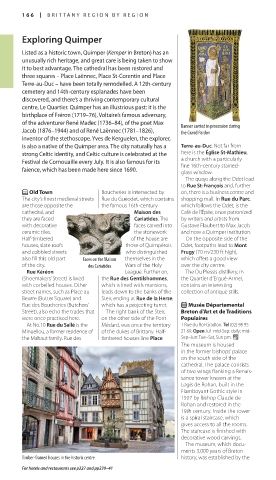
Timber-framed houses in the historic centre history, was established by the
For hotels and restaurants see p227 and pp239–41
166-167_EW_Brittany.indd 166 11/3/16 12:48 PM

